



Most people asking where to visit the Great Wall of China are really asking: Which section fits my trip? Beijing alone has more than a dozen accessible sections, and they are not interchangeable. Some are restored and easy to reach; others consist of original 600-year-old stone with barely a path. This guide covers six sections worth your time, from the most famous to the most photogenic, with honest notes on what each one actually offers.
- Most accessible: Badaling, direct high-speed rail from central Beijing, 20–40 minutes
- Best for scenery: Mutianyu in autumn (red leaf season from mid-October to early November)
- Best for photographers: Jinshanling, ideal for shooting at sunrise and sunset
- Most original: Simatai, the only section that retains intact Ming-dynasty construction without modern restoration
- Most unusual: Huanghua Cheng Water Great Wall, where a reservoir flooded three sections of wall
1. Badaling: The Most Visited Section
Badaling (八达岭 [Bādálǐng]) is what most people picture when they think of the Great Wall: wide, well-preserved, and built for impressive photographs. It sits at 1,015 metres above sea level and was the first section opened to tourists. Over 100 million visitors have walked alonged it, including more than 300 world leaders and heads of state. It is a UNESCO World Heritage Site and a 5A-rated scenic area, the highest designation in China’s tourism system.
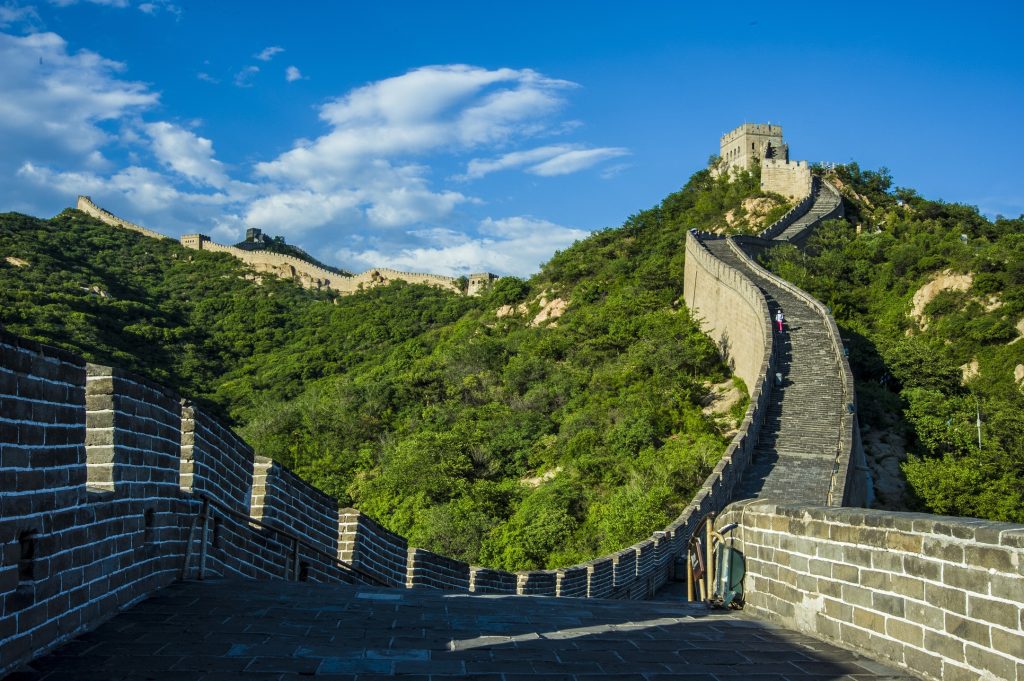
The wall is divided into a north section (12 watchtowers, steeper) and a south section (7 watchtowers, gentler). A single ticket covers both. The north section’s highest point, North Tower 8, is called 好汉坡 [hǎohàn pō] (Hero Slope) and is the most photographed spot. The south section offers better light for late afternoon photography.
Best seasons: March to May for mountain flowers; September to November for autumn colour and clear skies.
Tickets: 40 RMB peak (April–October), 35 RMB off-season. Students and elderly: 25 RMB. Under-18 and over-60: free.
Transport: High-speed rail from Beijing North or Qinghe Station, 20–30 minutes. Bus 877 from Muchengdi, about 2 hours, 6 RMB. By car, navigate to P1 Car Park.
Cable cars: Gondola to North Tower 7, single 100 RMB / return 140 RMB. Ground cable car to South Tower 4, single 80 / return 120 RMB. Toboggan slide from North Tower 4, cash only on site.
2. Mutianyu: The Favourite Among International Visitors
Mutianyu (慕田峪 [Mùtiányù]) in Huairou District is the most popular section among international visitors, and for good reason. The wall here is 5,400 metres long with 22 watchtowers, the open section runs 2,250 metres, and the landscape around it is densely forested hillsides that turns spectacular in autumn. Three watchtowers built side by side on a single platform, known as the Zhengguantai [zhèngguāntái], are an architectural oddity found nowhere else on the entire wall.
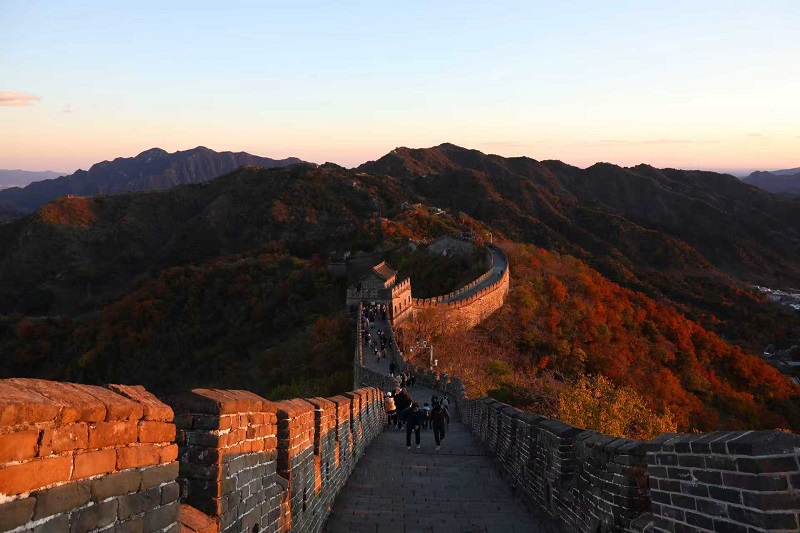
Former US President Bill Clinton, UK Prime Minister John Major and dozens of other foreign heads of state have all walked Mutianyu. Tower 15 was used as a filming location in the movie If You Are the One 2. Tower 14 has a wall where visitors can leave marker-pen notes.
Best seasons: Mid-October to early November for the red leaf season. April for the Mountain Flower Festival, with apricot and peach blossoms across the hillsides.
Tickets: 45 RMB adult, 25 RMB student. Park shuttle bus 15 RMB return (recommended; the walk to the cable car base is 3.5 km uphill).
Cable cars: Western enclosed gondola to Tower 14, single 100 / return 140 RMB. Eastern chairlift to Tower 6, same price. Toboggan slide (1,580 m) from Tower 6: 100 RMB. The two systems use separate tickets.
Transport: Direct tourist bus from Chaoyang Gate subway station Exit A, departing 07:30–09:00. Bus 916 from Dongzhimen to Huairou, then taxi.
3. Juyongguan: The Pass That Guards Beijing
Juyongguan (居庸关 [Jūyōngguān]) is one of the three major passes of the Ming Great Wall and has been a military checkpoint for more than 2,000 years. The gatehouse carries a plaque reading “Heaven’s First Pass” (天下第一雄关 [tiānxià dìyī xióngguān]). Furthermore, it is one of the most convenient sections to reach: 50 km from central Beijing along the Jingzang Highway.

Unlike Badaling, which is flat enough for a leisurely walk, Juyongguan is genuinely steep. Some steps require climbing on hands and feet. However, the reward is a wall that feels more like genuine hiking. The east route (from the north gate) is gentler and reaches the highest point at Tower 6 in about an hour. In contrast, the west route is more challenging, reaching Tower 12 in 2–3 hours. A full east-west loop runs 5–6 km and takes 3–5 hours.
Inside the pass, the Cloud Platform (云台 [Yúntái]) is a white marble Yuan Dynasty arch with Buddhist carvings and inscriptions in six scripts. It is one of the finest pieces of medieval stonework accessible to tourists in Beijing.
Best seasons: Late March to mid-April for “train through the flowers” season, when the S2 railway passes through the valley during the blossom period. October to November for autumn colour.
Tickets: 45 RMB peak (April–November), 40 RMB off-season. Under-18 and over-60: free.
Transport: Bus 919 (slow service) from Deshengmen, alight at Juyongguan. Drive to Car Park 3 (near Yuntai); parking fee is 10 RMB.
4. Jinshanling: The Photographer’s Great Wall
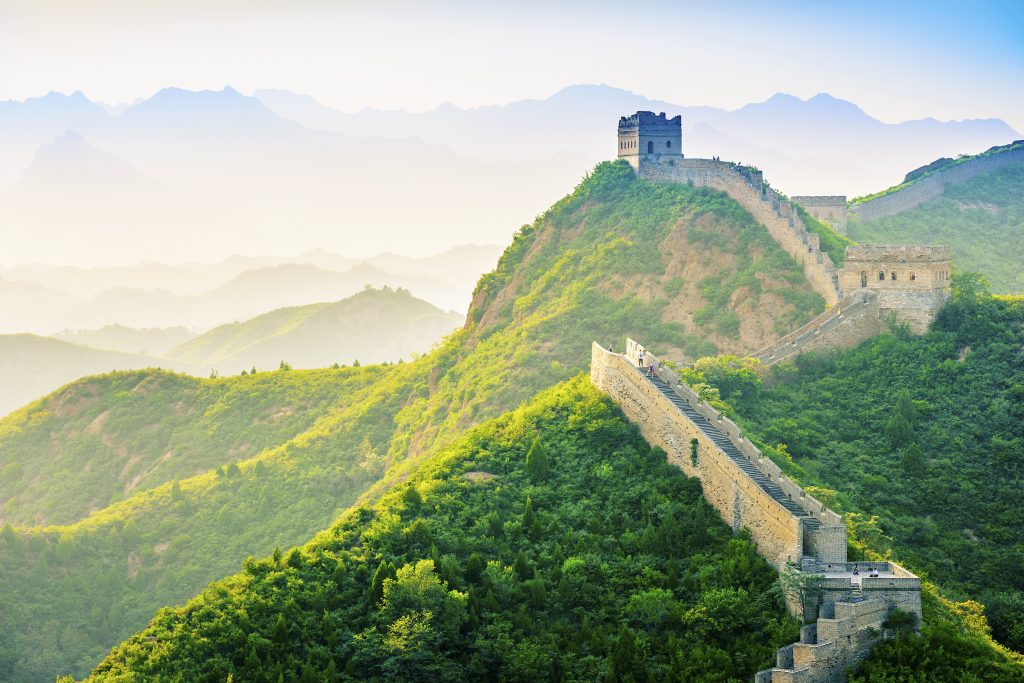
Jinshanling (金山岭 [Jīnshānlǐng]) sits on the border between Beijing’s Miyun District and Hebei Province, 130 km from central Beijing. It was built and personally overseen by Qi Jiguang (戚继光 [Qī Jìguāng]), the Ming-dynasty general who also modernised the wall’s military architecture. The result is one of the most varied and photogenic sections anywhere: watchtowers of different heights, a “Brick-Text Wall” where soldiers’ names are still visible in the masonry, and open ridgelines with unobstructed views in both directions.
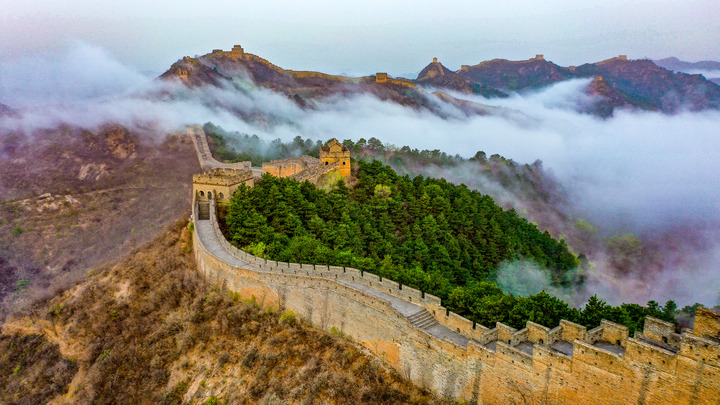
Jinshanling is the first choice for photographers. In particular, sunrise and sunset shots from the wall, particularly from the area around Little Jinshanling Tower (小金山楼) and General Tower (将军楼), are among the most reproduced Great Wall images in the world. After summer rain, a sea of clouds forms in the valley below the wall. Additionally, the autumn red leaf season peaks around 15–20 October.
Best seasons: Early April for the apricot blossom festival; mid-October for red leaves.
Tickets: 65 RMB peak (16 March–15 November), 55 RMB off-season. Cable car: single 40 RMB / return 80 RMB.
Transport: By car, follow the Jingcheng Expressway to Jinshanling Exit,130 km / 2 hours from Beijing. Tourist bus from Dongzhimen, 50 RMB, departs 08:00.
5. Huanghua Cheng Water Great Wall
Huanghua Cheng (黄花城 [Huánghuāchéng]) Water Great Wall in Huairou is unlike any other section. When the local reservoir was built in the 20th century, the water level rose high enough to submerge three sections of Ming-dynasty wall. The result is a landscape where stone watchtowers stand half-submerged in a lake, with the rest of the wall climbing up the surrounding hills. Rowing a boat past a flooded Great Wall is an experience that cannot be replicated at any other site in Beijing.
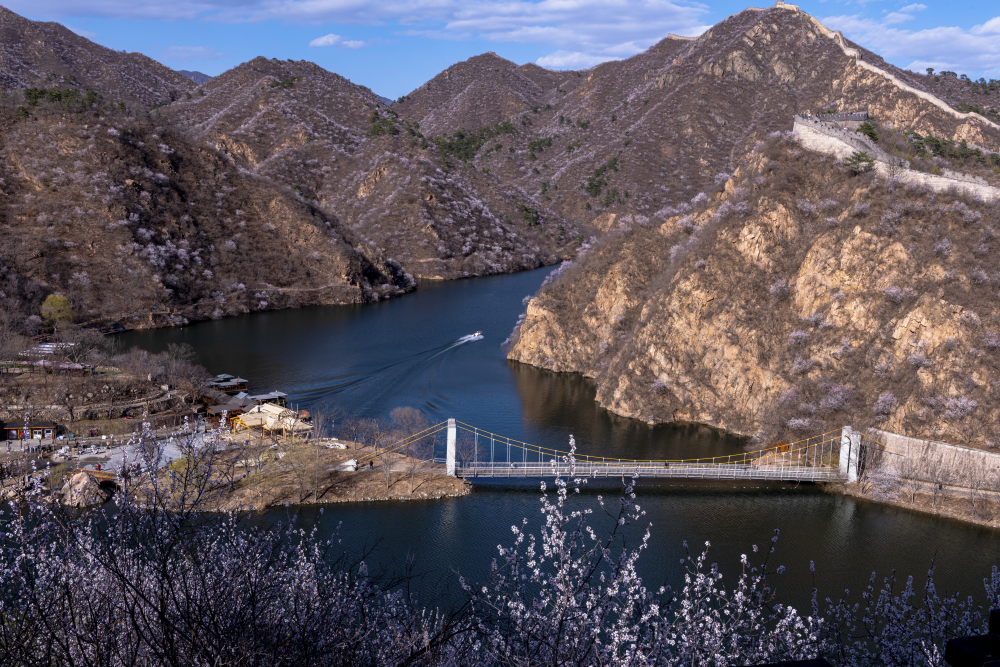
Beyond the water section, the park includes a 600-year-old Ming-dynasty chestnut orchard (you can pick your own in autumn), a glass-bottomed walkway above the submerged wall section, a forest train, a glass toboggan and a rowing area. As a result, it is one of the most activity-dense Great Wall parks in the region.
Best seasons: April for mountain peach and apricot blossom; October to November for autumn leaves and chestnut harvest.
Tickets: 60 RMB adult, 30 RMB student/elderly. Boat 25 RMB, small train 40 RMB, toboggan 120 RMB return, rafting 80 RMB.
Transport: By car to P3 Car Park, 20 RMB per day. Take Bus 916 express from Dongzhimen to Nanyuanyuan Three District, then transfer to the Huairou–Water Great Wall shuttle bus.
6. Simatai: The Original Wall
Simatai (司马台 [Sīmǎtái]) in Miyun District is the only section of the Great Wall in China that retains the original Ming-dynasty construction without post-1980s restoration. The Times of London named it one of the 25 must-see landscapes in the world. UNESCO has designated it the “Original Great Wall”. The wall here crosses genuinely vertiginous terrain: single-edge sections where one side drops away entirely, a “sky ladder” section at 85 degrees, and a sky bridge between two peaks.
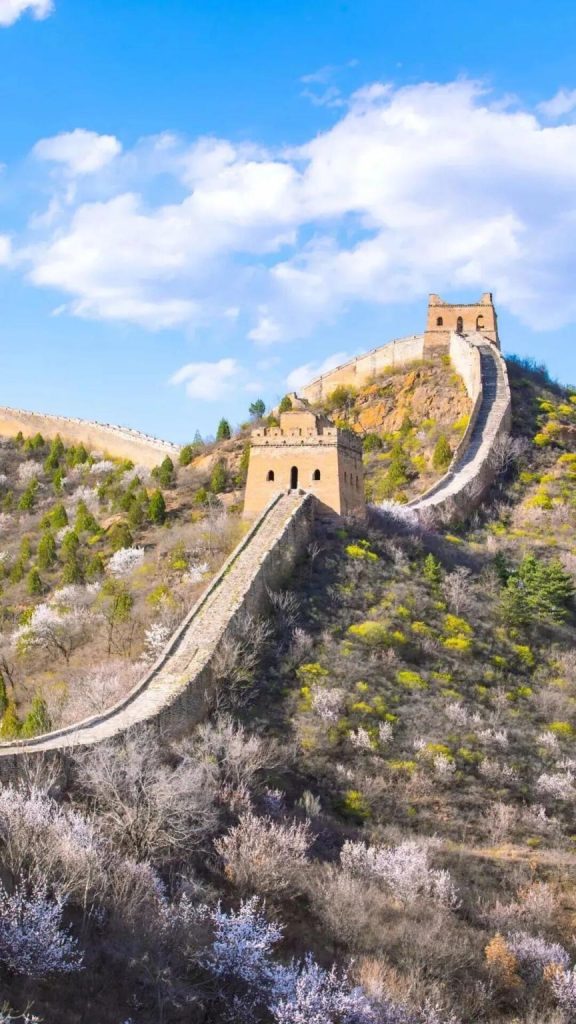
Simatai is built beside the ancient town of Gubei Water Town (古北水镇 [Gǔběi Shuǐzhèn]), a reconstructed Ming-Qing settlement at the base of the wall that operates as a hotel and entertainment complex. The combination of the original wall above and the atmospheric town below makes Simatai worth a longer visit or an overnight stay. Moreover, night tours are available on Fridays and Saturdays, with cable cars, floodlit wall sections and view over the lit-up ancient town.
Best seasons: Spring wildflowers (April–May), summer sea of clouds after rain, October red leaves, and winter snow all offer distinct experiences.
Tickets: Hiking-only 40 RMB. Single cable car combo: 150 RMB. Return cable car combo: 220 RMB. Night tours (Fri/Sat only): 120 RMB. Advance reservation required; three timed entry sessions daily: 10:00, 12:00, 14:00.
Transport: By car, Jingcheng Expressway to Gubei Water Town P1 Car Park, about 120 km and 1.5–2 hours. Tourist bus departs from Dongzhimen, 48 RMB, 1.5–2 hours.
How to Choose
If this is your first visit and easy transport is your top priority, Badaling is the answer. For better scenery with manageable crowds, Mutianyu in autumn is hard to beat. Photographers and visitors seeking a remote wilderness Great Wall will find Jinshanling well worth the longer journey. For something nobody else in your group has done, the submerged sections at Huanghua Cheng or the original stonework at Simatai will leave you with fond memories to recount at home..
For detailed dinning opinion near each section, see our restaurant guides for Badaling and Mutianyu. If you are travelling with children or older relatives, our guide on visiting the Great Wall with kids and elderly relatives covers accessible cable car routes at both sections.
FAQ
Which section of the Great Wall is closest to Beijing city centre?
Juyongguan is the nearest major section, about 50 km from central Beijing accessible by public bus from Deshengmen in under 90 minutes. Badaling follows at around 75 km, though the direct high-speed rail makes the travel time shorter in practice (20–30 minutes from Beijing North Station). Both are ideal for a half-day trip with no early start required.
How long does it take to visit the Great Wall from Beijing?
Allow a full day for any section. One-way travel time ranges from 40 minutes to 2 hours, depending on the section and transport method. Most visitors spend 2–4 hours exploring the wall. Badaling, accessible by high-speed rail, offers the fastest door-to-door journey. Jinshanling and Simatai, located farther afield, require more advance planning and are better suited to an early-start day trip or an overnight stay.
What is the best time of year to visit the Great Wall?
Autumn (late September to early November) is widely regarded the best season. Temperatures are comfortable, skies are clear, and the hillsides around most sections turn red and orange with seasonal foliage. Spring (March to May) is the second-best option, with mountain blossoms framing the wall. Summer is hot and humid, with the highest visitor numbers. Winter is cold but often uncrowded and offers dramatic snow photographs at sections like Simatai.
Is the Great Wall suitable for first-time visitors with no hiking experience?
Yes, if you choose the right section and use the cable cars. Badaling’s south route and Mutianyu’s western cable car route both enable visitors without hiking experience to reach proper viewpoints and walk a stretch of the wall at a comfortable pace. Jinshanling and Simatai have steeper terrain and are better suited to visitors who are comfortable with uneven ground and sustained climbs.
Do I need to book Great Wall tickets in advance?
Yes, this applies to all major Great Wall sections. Badaling, Mutianyu, Juyongguan and Simatai all require advance online reservation, and tickets for peak dates (Golden Week, May Day, weekends in the red leaf season) sell out days or weeks ahead. Book through the official scenic area websites or through established travel platforms. Simatai additionally requires pre-booking for timed entry slots all year round.
Have questions about visiting? Email hello@jollyeast.com and we’ll get back to you within 24 hours.