


-官网-1024x683.jpg)
Quick Summary
- The Forbidden City is 606 years old, was home to 24 emperors, and covers 720,000 square meters
- The “pig blood in the walls” legend has been officially debunked by palace management
- The “Cold Palace” was never a specific building; it was a form of imperial punishment
- Several permanent details in the palace mark specific historical moments, including a real arrowhead from an 1813 raid
It took 90,000 laborers to build it, commissioned by a single emperor. A 200-year-old arrowhead still embedded in a gate, a library roof painted the wrong color on purpose, a gate renamed because an emperor’s own name had become forbidden.
Why “Forbidden”? What the Name Actually Means
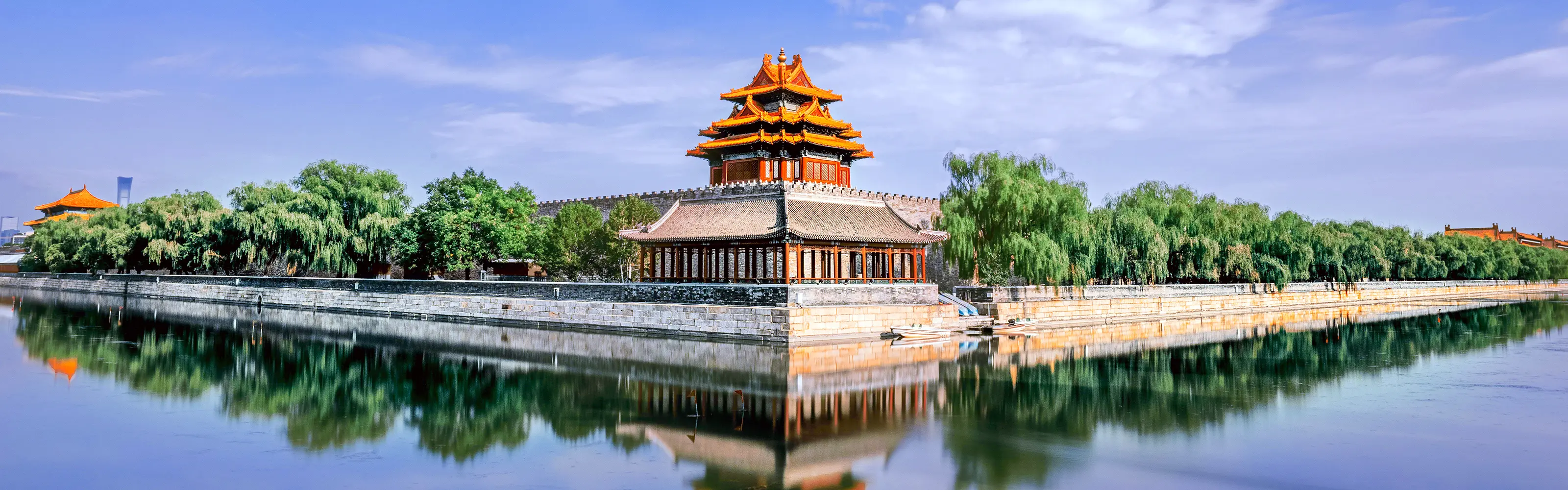
The Chinese name is Zijincheng [紫禁城], meaning “Purple Forbidden City.” Purple here has nothing to do with the color of the walls. It refers to Ziwei, the celestial pole star, the pole star around which all other celestial bodies revolve. The palace stood as the earthly mirror of that axis. To enter without permission was not just a crime. It was also seen as a violation of cosmic order.
That prohibition applied to almost everyone. Ordinary Beijing residents could live their whole lives with the palace walls in view and never once step inside. Most government officials got entry only on specific days, at specific gates, for specific purposes.
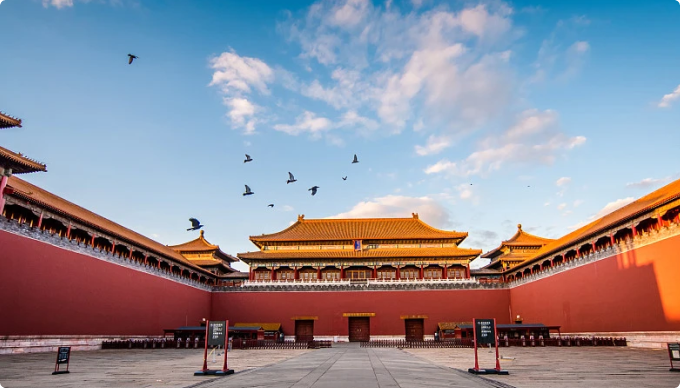
Today, walking through the Meridian Gate with a ticket lets visitors experience something unimaginable to ordinary people during its 492 years as an imperial residence.
Five Things Most Visitors Walk Past
1. The Stone Lions Are a Ranking System
Every major gate has a pair of stone lions, and they are not decorative. A male lion with one paw resting on a sphere signals imperial authority over the realm. A female lion with a paw resting on a small cub signals the continuation of the dynasty. Male on the left (east), female on the right (west). An open mouth symbolizes drawing in blessings, while a closed one keeps them within
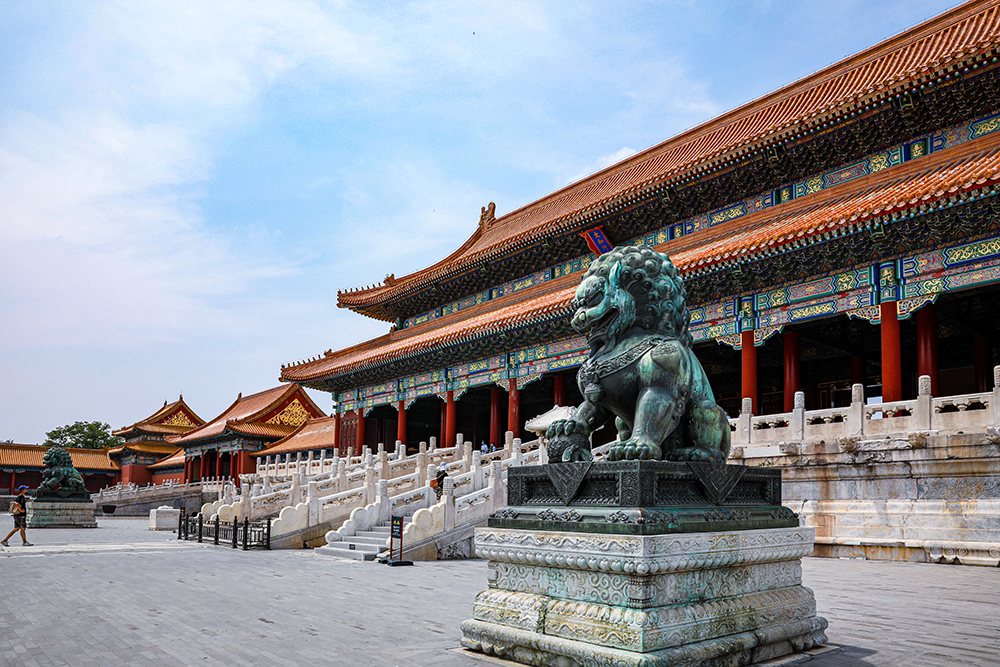
Count the curls in the mane. The higher the architectural rank, the more curls on the mane, following a uniform rule throughout the Forbidden City.
2. There Is a Real Arrowhead in the Longzong Gate
Look closely at the left door of the Longzong Gate [隆宗门], on the western side of the central axis. Embedded in the wood above the frame sits an arrowhead. It has been there since 1813.
That year, followers of the Tianli Sect broke into the Forbidden City with the collusion of palace servants. They reached the inner gateways before guards repelled them. The Jiaqing Emperor ordered the arrowhead left untouched as a lasting reminder of the imperial palace’s breach. It is still there, two centuries later. Most visitors walk past without seeing it.
3. One Building Has a Black Roof for a Specific Reason
Nearly all roof tiles across the Forbidden City are imperial golden yellow. But the Wenyuan Pavilion [文渊阁], the Qing dynasty’s imperial library, has black tiles.
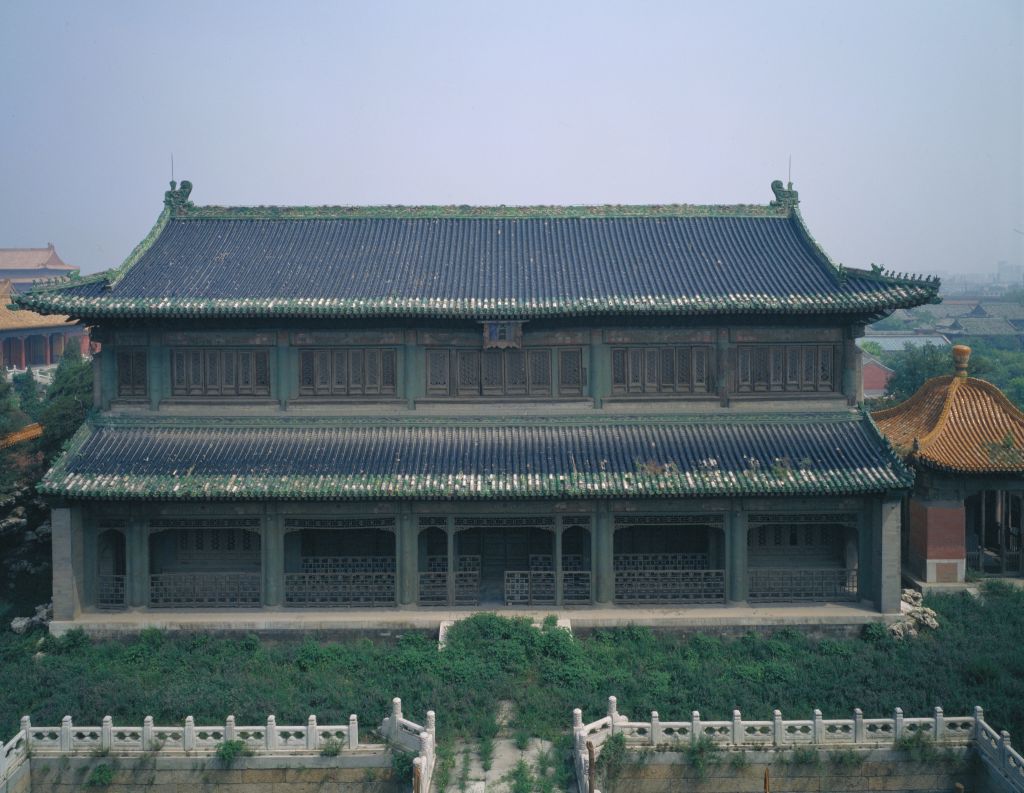
This choice was deliberate. In Five Elements theory, black belongs to water, and water overcomes fire. Housing priceless ancient manuscripts, the library needed all forms of protection, including symbolic geomantic design. The fireproofing logic ran all the way to the tile color. The black roof of one building among thousands of yellow ones is easy to miss, and easy to remember once you know why it’s there.
4. The Three Main Plazas Have No Trees — and the Reason Is Linguistic
The forecourts of the Hall of Supreme Harmony, the Hall of Central Harmony, and the Hall of Preserved Harmony are completely bare. No trees, no shade.
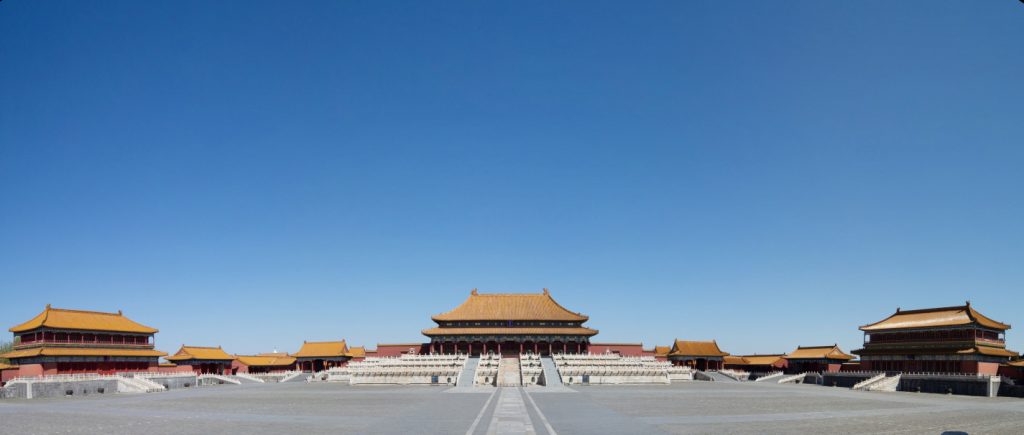
Part of this is practical: Trees could offer hiding spots during grand state ceremonies when the emperor appeared in full public view. But the symbolic reason matters too. The Chinese character for “trapped” [困] shows a tree (木) inside a square (口). Hence, such an inauspicious layout was never allowed before the empire’s most important halls.
5. The North Gate Has the Wrong Name
The north gate of the Forbidden City carries the name Shenwu Gate [神武门], meaning “Gate of Divine Military Might.” Yet the original name, the one it opened with in 1420, was Xuanwu Gate [玄武门].
The Kangxi Emperor’s personal name was Xuanye [玄烨]. In imperial tradition, using any character from the reigning emperor’s given name was strictly taboo in public. So the court renamed the gate out of respect. It has been Shenwu Gate ever since, and most visitors pass under it without knowing the story.
The Legends That Are True — and the Ones That Aren’t
Not true: The walls contain pig blood. Palace management has formally denied this. The red walls are painted with iron oxide pigment, selected for its vivid hue and excellent weather resistance.
Not true: Lightning burned ghostly silhouettes of palace ladies onto the walls. The famous “ghost photograph” in circulation online is actually an image a foreign photographer took in 1907. It shows Manchu women in traditional dress. And Scientifically speaking, lightning cannot magnetize red wall paint the way magnetic tape works.
Partly true: The Forbidden City has 9,999 and a half rooms. This legendary number is purely symbolic, not an actual count. A 1973 government survey put the figure at 8,707 rooms. A later, more detailed survey by the museum’s director gave 9,371. That said, The “9,999.5 rooms” notion stems from imperial cosmology: the heavenly palace had 10,000 rooms, so the mortal imperial palace had to have one half less. The half room exists — it sits in Wenyuan Pavilion.
The Layout Tells You What the Palace Valued
The Forbidden City follows a principle called qiánzhāo hòuqǐn [前朝后寝]: the Outer Court at the front for state affairs, and the Inner Court at the rear for daily imperial life.
The outer court occupies the southern half of the complex. Here the three great ceremonial halls stand: the Hall of Supreme Harmony, the Hall of Central Harmony, and the Hall of Preserved Harmony. The emperor used these for coronations, state examinations, and major announcements. They face south, toward the sun, maximizing natural light and symbolic harmony with the south.
The inner court takes up the northern half. The residential palaces, the quarters of the imperial consorts in six eastern and six western palaces, and the imperial garden at the far north end all belong here. This is the more human half of the complex.
Entering from the south and walking north, visitors travel a 960-meter path from imperial state power to private royal life amid the world’s most exquisitely structured architectural complex.
The Cold Palace: What It Really Was
No building in the Forbidden City has a sign reading “Cold Palace.” The term Lenggong (Cold Palace) refers not to a specific building, but to a form of imperial banishment.
A concubine who fell from favor could lose her title, lose her servants, and find herself confined to a locked section of the inner court with minimal resources. The emperor’s court stripped her of rank, cut off her support, and left her there. The cruelty lay not in the physical conditions but in the erasure: She remained confined within the palace walls, forgotten and isolated from the imperial court.
Consort Wang (Ming dynasty): Emperor Wanli confined her to Jingyang Palace [景阳宫] for ten years, barring her from seeing her own son, who was the Crown Prince. She died there in 1611.
Empress Nala (Qing dynasty): the Qianlong Emperor’s second empress, said to have cut her hair during a southern inspection tour, a ritual gesture of defiance that violated imperial etiquette. The emperor stripped her of her title and confined her to Yikun Palace [翊坤宫]. She died the following year without a posthumous name.
Pearl Concubine [珍妃]: a favorite of the Guangxu Emperor, she supported his reform movement. In 1900, as foreign forces advanced on Beijing and the court fled, Empress Dowager Cixi ordered her to be thrown into a well inside the palace. She was 24. The well still stands near the Palace of Tranquil Longevity, marked by a small sign that most visitors pass without stopping.
FAQ
Why is it called the Forbidden City?
The name comes from the Chinese Zijincheng, meaning “Purple Forbidden City.” Purple refers not to a color but to Ziwei, the celestial pole star around which the sky turns. The palace served as the earthly equivalent of that cosmic center. Entry without permission was forbidden to almost everyone for the entirety of its 492-year imperial history, including most government officials.
How many emperors lived in the Forbidden City?
Twenty-four emperors lived in the Forbidden City: 14 from the Ming Dynasty (1420–1644) and 10 from the Qing Dynasty (1644–1912). The last emperor, Puyi, abdicated in 1912 but continued living in the inner court until 1924, when a warlord government expelled him. The Palace Museum opened to the public the following year.
Is the Forbidden City the largest palace in the world?
Yes. The Forbidden City covers approximately 720,000 square meters and contains over 90 palace compounds, making it the world’s largest preserved palace complex. The Forbidden City holds 9,371 rooms by the most recent survey.
What is the most overlooked detail in the Forbidden City?
The arrowhead in the Longzong Gate is among the least-noticed details: embedded in the wood above the left door since the 1813 Tianli Sect raid, preserved there by imperial order as a permanent reminder. The Well of the Pearl Concubine, near the Palace of Tranquil Longevity, is another stop most visitors pass without knowing the story behind it.
Can you visit the Cold Palace in the Forbidden City?
There is no single “Cold Palace” to visit — the term described a type of confinement, not a fixed location. But several palaces where historical confinements took place are accessible: Jingyang Palace and Yikun Palace are open in the eastern and western inner court sections. The Well of the Pearl Concubine is marked and open near the northeastern section of the complex.
For official visitor information and exhibition guides, go to the Palace Museum’s official website.
Have questions about visiting? Email hello@jollyeast.com and we’ll get back to you within 24 hours. The experts here at JollyEast are more than happy to help!