
China travel made easy with JollyEast local experts.

Book Now

Forbidden City Dining Guide: Best Restaurants Inside & Nearby

You’ve just walked four hours through an 8,700-room palace. Now you’re hungry. Finding a good Forbidden City restaurant is less obvious than it sounds. The palace holds a handful of dining spots inside its red walls, but they close early and fill up fast. And yet, just outside the gates, the streets around the East Gate hold some of Beijing’s most satisfying eating: a Michelin Bib Gourmand noodle shop, a copper-pot hot pot place that has been feeding locals for 30 years, and one of the city’s most scenic Michelin-starred dining rooms. You’re in the right place.

Quick Summary

  • 4 dining spots inside the palace walls, including the historic Ice Cellar restaurant
  • Most inside venues stop serving by 14:30 — plan your lunch break before 13:00
  • Best budget meal nearby: Fangzhuan 69 Zhajiang Noodles (Michelin Bib Gourmand, from 40 yuan)
  • Best Peking duck near the palace: Sijiminfú at Donghua Gate (expect queues of 1–2 hours on weekends)
  • For a splurge: The Georg, a Michelin one-star with views of the East Gate moat

Eating Inside the Forbidden City

There are four dining outlets inside the Forbidden City. None are signature fine-dining spots, yet one boasts unique historic vibes and two are ideal for a midday stopover. All indoor restaurants cease service long before the palace closes, so please dine early.

The Ice Cellar Restaurant (故宫冰窖 Gùgōng Bīngjiào)

The Ice Cellar is the most atmospheric dining spot inside the palace. Qing Emperor Qianlong built the original ice storage here in the 18th century.

The menu runs set meals at around 55 yuan per person: braised beef noodles, old Beijing-style zhajiang noodles, and the palace-branded popsicles that visitors photograph more than they eat. The food is decent for a tourist venue.

The Ice Cellar opens Tuesday to Sunday, 10:30 to 14:30. It sits near the Compassion and Tranquility Palace (慈宁宫) on the west side of the complex. Arrive before 12:30 on busy days to avoid standing dining.

Wanchun Afternoon Tea (萬春金福 Wànchūn Jīnfú)

This small teahouse sits in the inner courtyard east of the Kunning Gate, halfway through the palace. The standout order is the lychee and plum drink (荔枝杨梅妃子饮 [lìzhī yángméi fēizǐ yǐn]): cold, sweet, and a little tart. Desserts lean traditional: sesame and walnut paste, court-style cakes. Budget around 50–80 yuan per person.

lychee and plum drink

But seats are limited and the space fills up quickly. If you arrive after 13:00, expect a short wait. The service counter also sells quick savory items if you want something faster.

The Palace Canteens

Two canteen-style restaurants operate near the Clock Museum and near Kunning Palace. Both serve standard Chinese comfort food: curry beef rice, braised beef noodles, kung pao chicken. Prices run around 60 yuan per person. The seating areas get cramped at peak hours and you may share a table.


Where to Eat Just Outside the Forbidden City

Top dining options are concentrated near Donghua Gate (East Gate东华门 [Dōnghuámén]). All recommended restaurants are within a 5-minute walk. No Chinese is needed for ordering, as all provide picture menus, English labels, or both.

Sijiminfú Peking Duck (四季民福 Sìjì Mínfú)

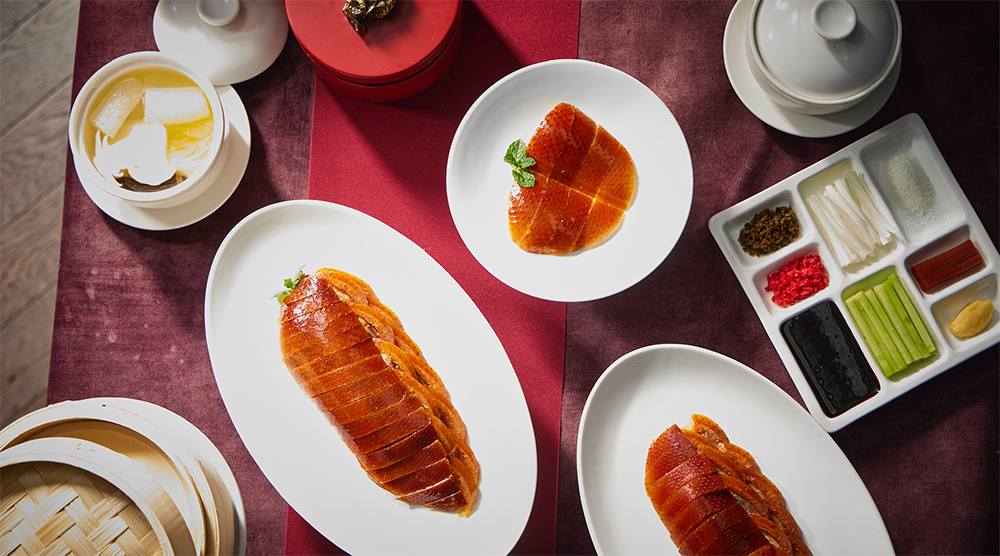
This is the top pick for Peking duck near the palace, and it earns the reputation. The duck arrives less oily than the big-name chains: the skin cracks sharply when pressed, and the meat stays tender inside. You eat it wrapped in thin pancakes with shredded cucumber and scallion. A few window seats look directly across at the red palace wall.

Queues at peak times (weekends and public holidays, especially the 11:00–13:00 lunch window) run 1–2 hours. The best workaround is to call ahead before you leave the palace and add your name to the waiting list. The restaurant is at 南池子大街11号, a two-minute walk from Donghua Gate. Budget around 150–165 yuan per person.

Nanmen Copper Pot Hot Pot (南门铜锅涮肉 Nánmén Tóngguō Shuàn Ròu)

Hot pot is the meal Beijing eats on cold days. Nanmen sits about 100 metres from Donghua Gate and has run its version of old Beijing-style hot pot for 30 years. Budget around 80 yuan per person.

Beijing copper pot hot pot

Heyan Meat Pies (河沿肉饼 Héyán Ròubǐng)

Flatbread stuffed with beef and spring onion, pan-fried until the crust blisters. That’s the whole pitch, and it’s enough. The filling is thick and savory, juicy at the centre. Heyan tops Beijing’s Dianping ranking for beef pancakes and sits on Donghua Gate Street, less than a five-minute walk from the east exit. Budget around 55 yuan per person. Come before noon or after 14:00 to skip the lunch queue.

Meat Pies
Meat Pies

Fangzhuan 69 Zhajiang Noodles (方砖厂69号炸酱面)

This is the most affordable option near the palace and one of the most decorated. Fangzhuan 69 has appeared on the Michelin Bib Gourmand list for six consecutive years, from 2020 through 2026. The hand-pulled wheat noodles are firm and springy. The slow-cooked pork sauce carries a deep savory note with a slight sweetness underneath. You stir in the raw toppings yourself: cucumber, radish, soybean sprouts. It’s methodical, and satisfying. Budget around 40 yuan per person.

The restaurant is near Wangfujing, a 10-minute walk from the east side of the palace. It’s also accessible from Exit B of Jinyu Hutong Station on Metro Line 8.


One Option for a Special Occasion: The Georg

The Georg opened in 2023, a Michelin one-star a few steps from Donghua Gate.

The food is Nordic-influenced, with dishes built around seasonal Chinese produce and premium seafood. Budget around 700 yuan per person. Book several weeks ahead for a window seat, especially in spring and autumn.

The Georg
The Georg

A Timing Note: Inside Options Close Early

Here is the most useful thing to know about eating inside the palace: all four venues stop serving well before the palace’s 17:00 closing time. The Ice Cellar closes service at 14:30. The teahouse and canteens stop at roughly the same time.

If you plan to dine inside, arrange your route to arrive before 13:00. If your schedule does not allow it, exit near the Clock Museum and walk 5 minutes to Donghua Gate for abundant lunch choices outside the palace.

Forbidden City Restaurant Guide: FAQ

Can I eat inside the Forbidden City?

Yes. Four dining options are available inside: the Ice Cellar Restaurant, Wanchun Afternoon Tea, and two palace canteens. All stop service well before the palace closes; arrive before 13:00 for easy seating.

What is the best restaurant near the Forbidden City?

Sijiminfú Peking Duck balances great taste and scenic palace views. For budget meals, Fangzhuan 69 Zhajiang Noodles offers unbeatable value with Michelin Bib Gourmand recognition.

Is Sijiminfú worth the wait?

Generally yes, but factor in the time. Weekend queues run 1–2 hours at peak times. If you’re on a tight schedule, call ahead to add your name to the waitlist before you leave the palace, or go on a weekday after 14:00 when the lunch crowd clears.

What is the cheapest option for eating near the Forbidden City?

Fangzhuan 69 Zhajiang Noodles costs around 40 yuan per person and holds a Michelin Bib Gourmand listing. Heyan Meat Pies runs about 55 yuan.

Do I need to book ahead for restaurants near the Forbidden City?

For most casual spots, no. Heyan Meat Pies, Nanmen Hot Pot, and the Fangzhuan noodle shop all take walk-ins. The Georg (Michelin one-star) requires advance booking, especially for window seats overlooking the moat. Sijiminfú doesn’t take formal reservations for walk-in tables but allows waitlist sign-ups by phone, which saves time on busy days.

Before heading to the palace, book your entry ticket at the official Forbidden City booking portal — no gate sales, no exceptions.

Have questions about visiting? Email us at hello@jollyeast.com and we’ll get back to you within 24 hours. The experts here at JollyEast are more than happy to help!

Forbidden City Tickets: The Complete 2026 Booking Guide

On-site ticket sales at the gate are not available. You must book every one of the 80,000 daily spots online in advance, linked to a specific passport number and a specific date. Arrive without a booking and you will be turned away.

This guide walks you through exactly how foreign visitors buy tickets, 2026 ticket prices, and what to do if your preferred date is already full.

Quick Summary

  • You must book all tickets online in advance — no gate sales, no exceptions
  • Peak season (April–October): ¥60 per person; off-season (November–March): ¥40
  • Tickets are released exactly 7 days in advance at 20:00 Beijing Time
  • Foreign visitors can book via the official English-language site using an international credit card
  • The Forbidden City closes every Monday (except public holidays)

The One Rule You Must Know

The Forbidden City operates a timed-entry reservation system. The system links every ticket to a visit date, a time slot, and the passport number of every visitor in your group. No booking, no entry.

The booking process is easy once you know the steps. You do not need Chinese language skills, a Chinese bank account, or a WeChat account. The English-language official portal accepts international credit cards.

Forbidden City Ticket Prices in 2026

Visitor typePeak season (Apr–Oct)Off-season (Nov–Mar)
Standard adult¥60¥40
University student (with ID)¥20¥20
Age 60 and above¥30¥20
Under 18 (Chinese citizens)FreeFree

Add-on tickets for the two specialist galleries, available inside the palace on the day of your visit:

Foreign visitors over 18 pay the standard adult rate. Non-Chinese children do not automatically qualify for the free entry that applies to Chinese citizens under 18. Check the current policy at bookingticket.dpm.org.cn before your visit, as exemption rules can change.

How to Book Forbidden City Tickets Step by Step

Official English portal: bookingticket.dpm.org.cn. No Chinese phone number or WeChat account is required.

  1. Go to bookingticket.dpm.org.cn (English available in the top-right language toggle).
  2. Click “Buy Tickets” and select your visit date.
  3. Choose a time slot: morning (8:30 entry) or afternoon (11:00 entry).
  4. Enter your passport number, full name, and a contact number.
  5. Complete payment. You’ll receive a confirmation tied to your passport. No printed ticket required.

The whole process takes around 5 minutes with your passport ready.

The 8pm Rule: When to Buy

Tickets are released exactly 7 days in advance at 20:00 Beijing Time.Popular dates such as national holidays and spring/autumn weekends sell out within minutes.Afternoon slots are always easier to book than morning ones. For flexible itineraries, choose the 11:00 entry slot for a higher success rate.

Booking Tips for Peak Periods:

Morning or Afternoon: Which Slot Works Best

Morning Slot (8:30 entry)

Quieter atmosphere with soft morning light; fewer tour groups before 10:00. Disadvantage: tickets are harder to book and require an early start.

Afternoon Slot (11:00 entry)

More relaxed schedule, with around 4 hours available before closing at 17:00. Late afternoon autumn light creates stunning amber tones on the golden roof tiles.

Note: Both Treasure Gallery and Clock Museum stop admission at 16:00. If entering at 11:00, arrange your gallery visit before 15:00.

The Treasure Gallery and Clock Museum: Worth the Extra 10 Yuan

Both galleries are located inside the Forbidden City and can be purchased online with main tickets or on-site after entering via the Meridian Gate.

Treasure Gallery

Displays imperial crowns, jade carvings and royal gold relics spanning centuries. The Phoenix Crown of Empress Xiaojing is the highlight. Allow at least 90 minutes for a full visit.

Clock Museum

Features exquisite European antique clocks and mechanical automata collected by the Qing imperial court. Allow around 45 minutes for the visit.

Practical tip: Visit the Clock Museum first, then reserve more time for the Treasure Gallery. Both close admission at 16:00.


What to Do if Tickets Are Sold Out

Fully booked dates do not mean no access:

Important reminder: Do not buy tickets from scalpers or unofficial third-party platforms. The Forbidden City does not authorize any external agents, and unofficial tickets are invalid for entry.

Cancellation Rules

You can cancel your ticket up to 24:00 the day before your visit. Do it through the same portal or WeChat mini-programme you used to book, and you’ll receive a full refund. Cancel on the day of your visit before 20:00 and it counts as one “no-show” strike. Three no-show strikes within 180 days and the system locks you out of bookings for 60 days.

So if your plans change, cancel early. It protects both your refund and your booking access.

Before You Go: A Short Checklist


Forbidden City Tickets: FAQ

Can I buy Forbidden City tickets at the gate?

No. The Forbidden City operates an advance booking system with no on-the-day counter sales. All tickets require prior reservation through the official portal at bookingticket.dpm.org.cn. Seniors aged 60 and above and children under 18 can collect a free ticket at the service centre between the Duanmen and Meridian Gate, but they still need to pre-register online before arriving.

How much do Forbidden City tickets cost in 2026?

Main entrance ticket:

Treasure Gallery and Clock Museum are each an extra ¥10 per person.

Valid student ID holders (aged 18+) enjoy a flat rate of ¥20 all year round.

Is it worth visiting both the Treasure Gallery and the Clock Museum?

Yes, if you have a full day. Each costs 10 yuan and adds around 45–90 minutes to your visit.

What happens if I miss my entry time slot?

Morning ticket holders must enter by 12:00. Afternoon ticket holders can enter from 11:00 onwards. If you miss the morning cutoff, you cannot enter on that ticket. Contact the official portal if your plans change.

Can I visit the Forbidden City without a Chinese phone number?

Yes. The English booking portal at bookingticket.dpm.org.cn accepts international passport numbers and does not require a Chinese phone number. Enter a valid international contact number during registration. You don’t need WeChat, Alipay, or any Chinese app to complete the booking. A standard credit or debit card handles payment on the international portal.

Planning a visit to the Forbidden City? Email us at hello@jollyeast.com and we’ll get back to you within 24 hours. The experts here at JollyEast are more than happy to help!

Facts About the Forbidden City Most Visitors Miss

It took 90,000 laborers to build it, commissioned by a single emperor. A 200-year-old arrowhead still embedded in a gate, a library roof painted the wrong color on purpose, a gate renamed because an emperor’s own name had become forbidden.

Quick Summary

  • The Forbidden City is 606 years old, was home to 24 emperors, and covers 720,000 square meters
  • The “pig blood in the walls” legend has been officially debunked by palace management
  • The “Cold Palace” was never a specific building; it was a form of imperial punishment
  • Several permanent details in the palace mark specific historical moments, including a real arrowhead from an 1813 raid

Why “Forbidden”? What the Name Actually Means

The Chinese name is Zijincheng [紫禁城], meaning “Purple Forbidden City.” Purple here has nothing to do with the color of the walls. It refers to Ziwei, the celestial pole star, the pole star around which all other celestial bodies revolve. The palace stood as the earthly mirror of that axis. To enter without permission was not just a crime. It was also seen as a violation of cosmic order.

That prohibition applied to almost everyone. Ordinary Beijing residents could live their whole lives with the palace walls in view and never once step inside. Most government officials got entry only on specific days, at specific gates, for specific purposes.

Today, walking through the Meridian Gate with a ticket lets visitors experience something unimaginable to ordinary people during its 492 years as an imperial residence.

Five Things Most Visitors Walk Past

1. The Stone Lions Are a Ranking System

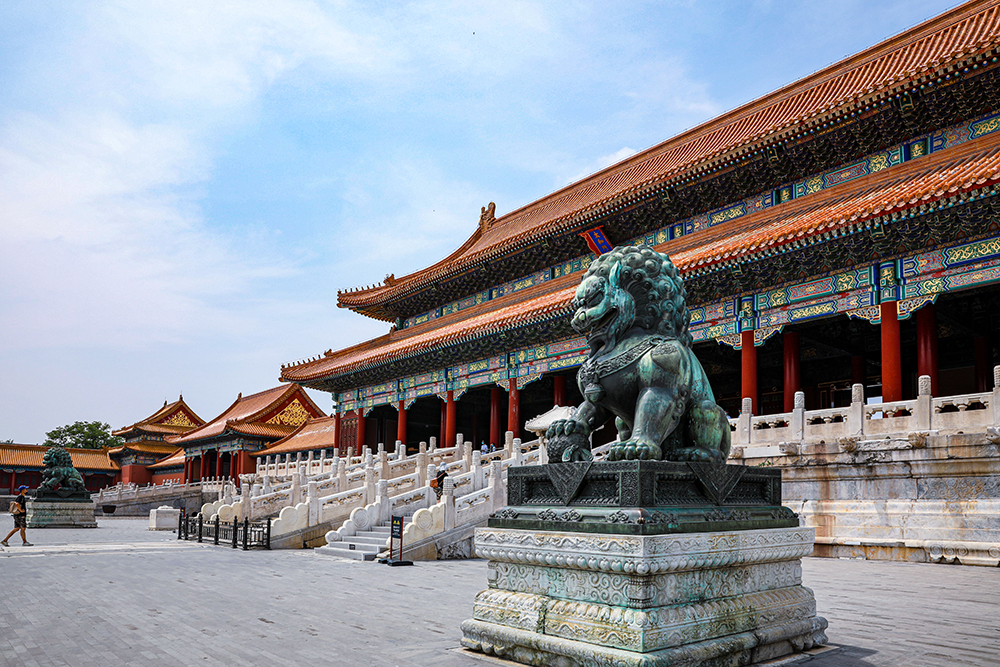
Every major gate has a pair of stone lions, and they are not decorative. A male lion with one paw resting on a sphere signals imperial authority over the realm. A female lion with a paw resting on a small cub signals the continuation of the dynasty. Male on the left (east), female on the right (west). An open mouth symbolizes drawing in blessings, while a closed one keeps them within

Count the curls in the mane. The higher the architectural rank, the more curls on the mane, following a uniform rule throughout the Forbidden City.

2. There Is a Real Arrowhead in the Longzong Gate

Look closely at the left door of the Longzong Gate [隆宗门], on the western side of the central axis. Embedded in the wood above the frame sits an arrowhead. It has been there since 1813.

That year, followers of the Tianli Sect broke into the Forbidden City with the collusion of palace servants. They reached the inner gateways before guards repelled them. The Jiaqing Emperor ordered the arrowhead left untouched as a lasting reminder of the imperial palace’s breach. It is still there, two centuries later. Most visitors walk past without seeing it.

3. One Building Has a Black Roof for a Specific Reason

Nearly all roof tiles across the Forbidden City are imperial golden yellow. But the Wenyuan Pavilion [文渊阁], the Qing dynasty’s imperial library, has black tiles.

Wenyuan Pavilion
Wenyuan Pavilion

This choice was deliberate. In Five Elements theory, black belongs to water, and water overcomes fire. Housing priceless ancient manuscripts, the library needed all forms of protection, including symbolic geomantic design. The fireproofing logic ran all the way to the tile color. The black roof of one building among thousands of yellow ones is easy to miss, and easy to remember once you know why it’s there.

4. The Three Main Plazas Have No Trees — and the Reason Is Linguistic

The forecourts of the Hall of Supreme Harmony, the Hall of Central Harmony, and the Hall of Preserved Harmony are completely bare. No trees, no shade.

Hall of Supreme Harmony

Part of this is practical: Trees could offer hiding spots during grand state ceremonies when the emperor appeared in full public view. But the symbolic reason matters too. The Chinese character for “trapped” [困] shows a tree (木) inside a square (口). Hence, such an inauspicious layout was never allowed before the empire’s most important halls.

5. The North Gate Has the Wrong Name

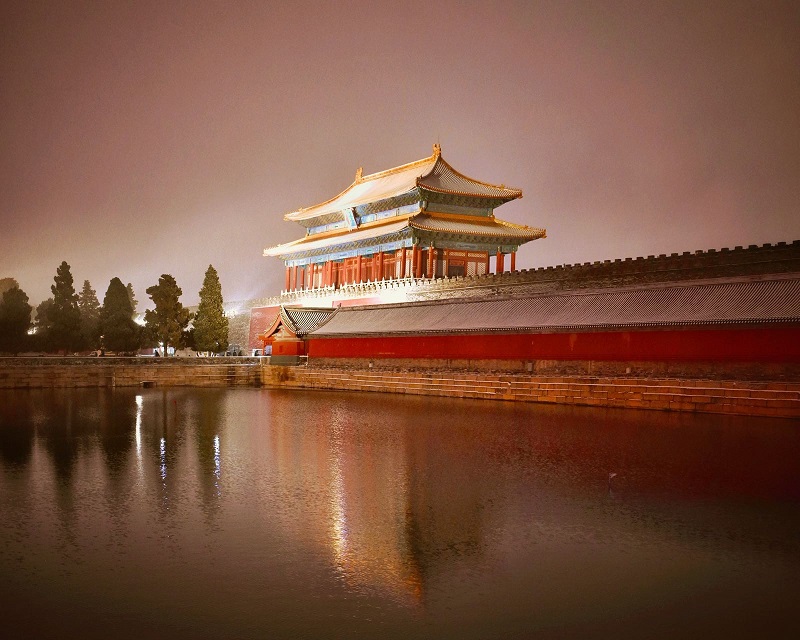
The north gate of the Forbidden City carries the name Shenwu Gate [神武门], meaning “Gate of Divine Military Might.” Yet the original name, the one it opened with in 1420, was Xuanwu Gate [玄武门].

The Kangxi Emperor’s personal name was Xuanye [玄烨]. In imperial tradition, using any character from the reigning emperor’s given name was strictly taboo in public. So the court renamed the gate out of respect. It has been Shenwu Gate ever since, and most visitors pass under it without knowing the story.


The Legends That Are True — and the Ones That Aren’t

Not true: The walls contain pig blood. Palace management has formally denied this. The red walls are painted with iron oxide pigment, selected for its vivid hue and excellent weather resistance.

Not true: Lightning burned ghostly silhouettes of palace ladies onto the walls. The famous “ghost photograph” in circulation online is actually an image a foreign photographer took in 1907. It shows Manchu women in traditional dress. And Scientifically speaking, lightning cannot magnetize red wall paint the way magnetic tape works.

Partly true: The Forbidden City has 9,999 and a half rooms. This legendary number is purely symbolic, not an actual count. A 1973 government survey put the figure at 8,707 rooms. A later, more detailed survey by the museum’s director gave 9,371. That said, The “9,999.5 rooms” notion stems from imperial cosmology: the heavenly palace had 10,000 rooms, so the mortal imperial palace had to have one half less. The half room exists — it sits in Wenyuan Pavilion.

The Layout Tells You What the Palace Valued

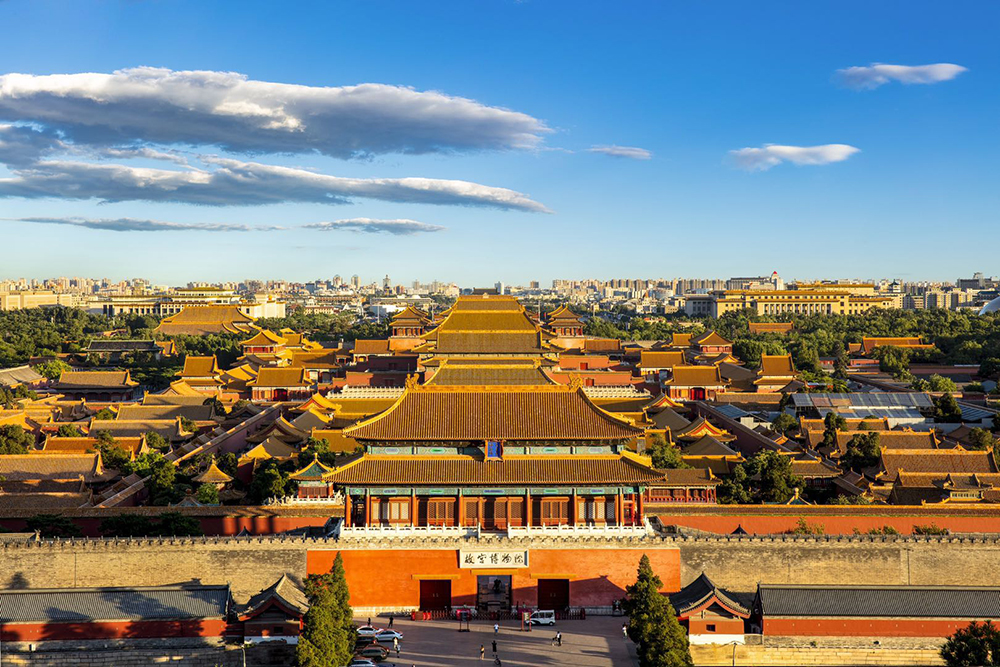
The Forbidden City follows a principle called qiánzhāo hòuqǐn [前朝后寝]: the Outer Court at the front for state affairs, and the Inner Court at the rear for daily imperial life.

The outer court occupies the southern half of the complex. Here the three great ceremonial halls stand: the Hall of Supreme Harmony, the Hall of Central Harmony, and the Hall of Preserved Harmony. The emperor used these for coronations, state examinations, and major announcements. They face south, toward the sun, maximizing natural light and symbolic harmony with the south.

The inner court takes up the northern half. The residential palaces, the quarters of the imperial consorts in six eastern and six western palaces, and the imperial garden at the far north end all belong here. This is the more human half of the complex.

Entering from the south and walking north, visitors travel a 960-meter path from imperial state power to private royal life amid the world’s most exquisitely structured architectural complex.


The Cold Palace: What It Really Was

No building in the Forbidden City has a sign reading “Cold Palace.” The term Lenggong (Cold Palace) refers not to a specific building, but to a form of imperial banishment.

A concubine who fell from favor could lose her title, lose her servants, and find herself confined to a locked section of the inner court with minimal resources. The emperor’s court stripped her of rank, cut off her support, and left her there. The cruelty lay not in the physical conditions but in the erasure: She remained confined within the palace walls, forgotten and isolated from the imperial court.

Consort Wang (Ming dynasty): Emperor Wanli confined her to Jingyang Palace [景阳宫] for ten years, barring her from seeing her own son, who was the Crown Prince. She died there in 1611.

Empress Nala (Qing dynasty): the Qianlong Emperor’s second empress, said to have cut her hair during a southern inspection tour, a ritual gesture of defiance that violated imperial etiquette. The emperor stripped her of her title and confined her to Yikun Palace [翊坤宫]. She died the following year without a posthumous name.

Pearl Concubine [珍妃]: a favorite of the Guangxu Emperor, she supported his reform movement. In 1900, as foreign forces advanced on Beijing and the court fled, Empress Dowager Cixi ordered her to be thrown into a well inside the palace. She was 24. The well still stands near the Palace of Tranquil Longevity, marked by a small sign that most visitors pass without stopping.

Concubine Zhen Well
Concubine Zhen Well

FAQ

Why is it called the Forbidden City?

The name comes from the Chinese Zijincheng, meaning “Purple Forbidden City.” Purple refers not to a color but to Ziwei, the celestial pole star around which the sky turns. The palace served as the earthly equivalent of that cosmic center. Entry without permission was forbidden to almost everyone for the entirety of its 492-year imperial history, including most government officials.

How many emperors lived in the Forbidden City?

Twenty-four emperors lived in the Forbidden City: 14 from the Ming Dynasty (1420–1644) and 10 from the Qing Dynasty (1644–1912). The last emperor, Puyi, abdicated in 1912 but continued living in the inner court until 1924, when a warlord government expelled him. The Palace Museum opened to the public the following year.

Is the Forbidden City the largest palace in the world?

Yes. The Forbidden City covers approximately 720,000 square meters and contains over 90 palace compounds, making it the world’s largest preserved palace complex. The Forbidden City holds 9,371 rooms by the most recent survey.

What is the most overlooked detail in the Forbidden City?

The arrowhead in the Longzong Gate is among the least-noticed details: embedded in the wood above the left door since the 1813 Tianli Sect raid, preserved there by imperial order as a permanent reminder. The Well of the Pearl Concubine, near the Palace of Tranquil Longevity, is another stop most visitors pass without knowing the story behind it.

Can you visit the Cold Palace in the Forbidden City?

There is no single “Cold Palace” to visit — the term described a type of confinement, not a fixed location. But several palaces where historical confinements took place are accessible: Jingyang Palace and Yikun Palace are open in the eastern and western inner court sections. The Well of the Pearl Concubine is marked and open near the northeastern section of the complex.

For official visitor information and exhibition guides, go to the Palace Museum’s official website.

Have questions about visiting? Email hello@jollyeast.com and we’ll get back to you within 24 hours. The experts here at JollyEast are more than happy to help!

How Many Rooms Are in the Forbidden City?

The legend claims 9,999 and a half rooms, while surveys show a smaller number. The actual count of rooms in the Forbidden City depends on how “room” is defined—and whether you believe a legend about an emperor’s dream.

The short answer is 9,371. Here’s why this number is more fascinating than it seems at first glance.

Quick Summary

  • The most authoritative count, from a 2012 survey led by the Palace Museum, is 9,371 rooms
  • A 1973 government survey counted 8,707 rooms — the difference stems from how “room” is defined
  • The famous “9,999.5” figure is symbolic, not a real measurement
  • There really is a half room, in Wenyuan Pavilion
  • Visitors can access roughly 60% of the complex during a standard visit

The Real Number: 9,371 Rooms

In 2012, Palace Museum director Shan Jixiang led a comprehensive architectural survey of the entire complex. The result: 9,371 rooms.

An earlier government survey from 1973 counted 8,707 rooms. Both figures are genuine counts by professionals with full access to the complex. The gap between them comes from methodology, specifically from how each team handled small service spaces, corridor sections, and partially enclosed areas. A stairwell alcove counts differently depending on the criteria.

Neither number is incorrect: the 2012 survey is more recent and detailed, and 9,371 is the figure the Palace Museum currently uses.

Why 9,999.5? The Story Behind the Legend

The most famous number associated with the Forbidden City is neither 9,371 nor 8,707—it’s 9,999.5.

The legend runs like this: Emperor Yongle, when he planned the construction in 1406, intended to build 10,000 rooms, matching what people believed to be the number of rooms in the Jade Emperor’s heavenly palace. One night, he dreamed that the Jade Emperor summoned him and demanded to know why he was building a palace the same size as Heaven’s. Yongle promised to build slightly fewer.

So he built 9,999 rooms. And then added half a room, to come as close as possible to the divine count without actually reaching it.

Whether or not this actually happened, the logic reflects something true about the palace’s design. The number 9 appears throughout: nine rows of nine gold studs on each major gate panel, nine ridgeline animal figurines on the Hall of Supreme Harmony’s roof, and proportions calibrated throughout to exploit 9’s symbolic weight as the largest single digit, associated with the emperor’s title of “Nine-Five Supremacy” [九五之尊].

What Actually Counts as a “Room”?

Here is the core of the counting problem: in ancient Chinese architecture, one “room” [间, jiān] is the space enclosed by four structural columns. This is not a room in any modern sense. It is a structural unit.

So the Hall of Supreme Harmony, the largest building in the complex, contains 55 rooms by this definition, because 72 columns arranged in a grid support it. A narrow corridor section with four pillars counts as one room. A small closet or service alcove counts as one room. A space used only for a staircase can count as half a room, if it occupies only half a structural bay.

The size of these “rooms” ranges from a few square meters to spaces large enough for a full state ceremony. That range is part of why surveys conducted decades apart produce different totals.


Where Is the Famous Half Room?

Two locations appear in the historical and architectural literature.

Wenyuan Pavilion [文渊阁] is the most widely accepted answer. At the western end of the pavilion’s ground floor sits a narrow space containing only a staircase, measuring roughly half the span of a standard structural bay. This is the most commonly cited location and the one the palace’s own documentation tends to reference.

Wenyuan Pavilion
Wenyuan Pavilion

Yizhai, in the Qianlong Garden [乾隆花园怡斋], appears in some architectural surveys as an alternative candidate, based on a structural anomaly in the private garden the Qianlong Emperor built within the inner court. Less commonly cited, but worth knowing.

If you want to find the half room on your visit: Wenyuan Pavilion sits on the eastern side of the outer court, north of the Gate of Literary Brilliance. The exterior is accessible from the courtyard, even when the interior is not open for general admission.

How Many Rooms Can You Actually Visit?

Most of the 9,371 rooms are not open to visitors during a standard visit. Since opening to the public in 1925, the palace has gradually opened more sections, but significant areas remain restricted for conservation, storage, or administrative purposes.

Current estimates suggest visitors can access roughly 60% of the total complex. That said, 60% of 9,371 still represents an enormous amount of ground. The main north-south axis alone runs approximately 960 meters from the Meridian Gate to the imperial garden.

A thorough visit covering the main ceremonial halls, the inner court, and the imperial garden takes three to four hours. Adding the Treasure Gallery and Clock Museum fills a comfortable full day. Even then, interior courtyards and smaller palace buildings that most visitors never reach are everywhere.

Imperial garden
 Imperial garden

The imperial garden at the northern end is among the most rewarding sections: ancient cypress trees filter the light into shifting columns, and the Taihu stone [太湖石] formations, eroded by thousands of years of water into porous and perforated shapes, stand in striking contrast to the strict geometry everywhere else in the palace.

The Scale in Perspective

For a comparison: the Palace of Versailles, often cited as Europe’s grandest royal residence, contains approximately 2,300 rooms in the main palace building. Buckingham Palace has 775 rooms. The White House has 132.

The Forbidden City has 9,371.

Even the lower 1973 count of 8,707 rooms makes it the largest palace complex by room count anywhere in the world. If you spent five minutes in each room and visited ten hours a day, you would need roughly 29 days to see every room—most visitors only have one day.


FAQ

How many rooms are in the Forbidden City?

The most accurate modern figure is 9,371 rooms, from a detailed survey by Palace Museum director Shan Jixiang in 2012. An earlier 1973 government survey counted 8,707.

Why do people say the Forbidden City has 9,999 and a half rooms?

The 9,999.5 figure comes from a legend about Emperor Yongle, who allegedly designed the palace to contain exactly one room fewer than the 10,000 believed to exist in the Jade Emperor’s heavenly palace.

Where is the half room in the Forbidden City?

The most widely accepted location is the western end of Wenyuan Pavilion [文渊阁]. A second candidate in the Qianlong Garden appears in some architectural surveys, but Wenyuan Pavilion is the more commonly cited and accepted answer.

How big is the Forbidden City compared to other palaces?

The Forbidden City covers approximately 720,000 square meters and contains 9,371 rooms. The Palace of Versailles contains roughly 2,300 rooms in its main building. Buckingham Palace has 775. By either measure, the Forbidden City sits in a different category from any other surviving royal residence.

How long does it take to walk through the Forbidden City?

Most visitors spend four to six hours covering the main axis, the inner court palaces, and the imperial garden. Adding the Treasure Gallery and Clock Museum extends the visit to a comfortable full day. Allow more time than you think you need.

For the full visitor guide and current exhibition listings, see the Palace Museum’s official website.

Have questions about visiting? Email hello@jollyeast.com and we’ll get back to you within 24 hours. The experts here at JollyEast are more than happy to help!

How Old Is the Forbidden City? 606 Years Explained

A palace that has been standing since 1420. How old is the Forbidden City? In 2026, the answer is 606 years old: older than the printing press reaching Europe, older than Columbus crossing the Atlantic.

Quick Summary

  • The Forbidden City was completed in 1420, making it 606 years old in 2026
  • Construction took 14 years, ordered by Emperor Yongle of the Ming Dynasty
  • 24 emperors resided here during the Ming and Qing dynasties for nearly 500 years of imperial reign.
  • It opened to the public as a museum on October 10, 1925
  • UNESCO listed it as a World Heritage Site in 1987

The Simple Answer: How Old Is the Forbidden City?

Construction began in 1406, under Emperor Yongle [永乐帝], the third emperor of the Ming Dynasty. Construction finished in 1420. That is the date historians use as the official start point.

But “built in 1420” understates what actually happened across those six centuries. The building you walk through today is not quite the one Yongle inaugurated. It has been burned, rebuilt, expanded, stripped, and carefully restored across three very different chapters of history, each of which left its mark on what you see now.

Meridian Gate
Meridian Gate

Phase One: The Emperor Who Moved a Capital (1406–1644)

Emperor Yongle was not born to rule. He was the fourth son of the Ming Dynasty’s founder and had been posted as a regional prince to the north, governing the territory centered on what is now Beijing. When his young nephew inherited the imperial throne, Yongle raised an army and took power by force in a civil war known as the Jingnan Campaign. Legitimacy was immediately a problem.

His solution, among others, was architecture. Moving the imperial capital from Nanjing (the dynasty’s original seat) to his own power base in the north required justification. Building the largest, most imposing palace complex in human history provided it. Work began in 1406.

What’s more, the scale of the construction effort was enormous. Timber came from forests in Sichuan and Yunnan, hauled thousands of kilometers north. Workers quarried white marble near Beijing and cut it into massive flagstones for the ceremonial courtyards. The imperial court conscripted craftsmen from across the empire for their specific skills.

Construction finished in 1420. The imperial seat moved from Nanjing to Beijing the following year.

For the next 224 years, through 14 Ming emperors, the Forbidden City stood as China’s political and ritual center. Then in 1644, the Ming Dynasty collapsed. A rebel force under Li Zicheng occupied the palace briefly before Qing armies arrived to drive them out. As Li Zicheng retreated, he burned only parts of the outer court and several gate towers. The core inner palaces remained largely intact when the Qing took over.

Phase Two: The Qing Dynasty Rebuilds (1644–1924)

Emperor Shunzhi entered Beijing in 1644 and chose the Forbidden City as his seat. The Qing did not rebuild most buildings from scratch. They restored fire-damaged structures while fully keeping the original Ming layout and axial symmetry.

The Qing rebuilt all three main ceremonial halls: the Hall of Supreme Harmony, the Hall of Central Harmony, and the Hall of Preserved Harmony. They also reconstructed most residential palaces, inner courtyard buildings and auxiliary facilities. Still, the overall layout, the north-south axial symmetry, and the fundamental scale all follow Yongle’s original plan.

the Hall of Supreme Harmony

The Qing also added structures that have become defining features of the palace. The Nine-Dragon Wall [九龙壁], the imperial opera house Changyin Pavilion [畅音阁], and the imperial library Wenyuan Pavilion [文渊阁] are all Qing-era additions, built over the following 150 years.

Ten Qing emperors ruled from here across 268 years. The last, Puyi [溥仪], ascended the throne in 1908 at the age of two. The Qing Dynasty fell in 1912, ended by the Republican Revolution. The new Republic allowed Puyi to remain in the inner court as a private individual, a strange twilight arrangement in which a former emperor inhabited a former palace as a tenant, until 1924, when a warlord government finally expelled him.

The inner courts where he lived through over those 12 years had grown cold, quiet, and increasingly disconnected from the city growing up outside the walls. The empire had ended. The palace had not yet found its next life.

Phase Three: From Imperial Palace to the World’s Biggest Museum (1925–Now)

On October 10, 1925, the Palace Museum [故宫博物院] officially opened to the public. For the first time in the Forbidden City’s 505-year history, ordinary people could walk through the Meridian Gate freely for the first time.

That transition mattered. Before 1925, everything inside (the artifacts, the archives, the buildings themselves) belonged to the imperial family. After 1925, it became a public institution. The collection that had accumulated across two dynasties, now totaling over 1.8 million objects, became one of the world’s great museum holdings.

What’s more, UNESCO designated the Forbidden City a World Heritage Site in 1987, one of China’s earliest batch of World Heritage sites. Today it holds China’s highest tourism classification (5A) and attracts roughly 14 million visitors annually. You can see ongoing restoration work in various parts of the complex. Given that it is a 606-year-old wooden structure exposed to Beijing’s extremes of summer heat and winter cold, this is exactly as it should be.


FAQ

When was the Forbidden City built?

Construction of the Forbidden City began in 1406 under Emperor Yongle of the Ming Dynasty and finished in 1420.

How long did it take to build the Forbidden City?

Fourteen years. Work began in 1406 and construction finished in 1420.

Who ordered the construction of the Forbidden City?

Emperor Yongle [永乐帝], the third emperor of the Ming Dynasty, ordered the construction.

When did the Forbidden City become a museum?

On October 10, 1925, the Palace Museum officially opened, making the Forbidden City publicly accessible for the first time in its history.

Is the Forbidden City still standing in its original form?

Not entirely. The layout and scale follow Yongle’s original plan, but most of the buildings you walk through today are Qing-era reconstructions rather than original Ming structures.

For current visiting hours, ticket prices, and exhibition information, visit the Palace Museum’s official website.

Have questions about visiting? Email hello@jollyeast.com and we’ll get back to you within 24 hours. The experts here at JollyEast are more than happy to help!