Emperors, Empresses and Scholars: The Hutongs with Famous Residents
The hutong, Beijing’s defining network of residential lanes, holds more history per alleyway than almost anywhere else in China. Behind these grey courtyard walls lived people who shaped the country: an empress who learned English before entering the Forbidden City, a writer who named his yard after its persimmon trees, a doctor who stopped a deadly plague, and an architect who gave the city its most lasting concept. Walk slowly through any hutong in Beijing, and the past still speaks through the brickwork.
Quick Summary
Beijing’s hutongs Were home to the last empress, pioneering writers, a plague-fighting physician, and the architects who preserved the city’s heritage
Maoer Hutong (帽儿胡同) 35–37 was the childhood home of Wanrong (婉容), who married the last emperor Puyi in 1922 at age 16
Dongdangzi Hutong (东堂子胡同) 75 is where Cai Yuanpei lived while planning the May 4th Movement of 1919
Several of the hutong residences are now open museums, including Lao She’s courtyard and the Mei Lanfang Memorial. Check our guide to the best hutongs in Beijing for planning tips
Liang Sicheng, who lived in Bei Zongbu Hutong (北总布胡同), coined the term 中轴线 (central axis); Beijing’s axis became a UNESCO World Heritage site in 2024
The Last Empress: Maoer Hutong, Beijing
Of all the stories hidden in the hutongs, Beijing’s Maoer Hutong (帽儿胡同) 35–37 carries perhaps the greatest weight of history. This courtyard was the childhood home of Wanrong (婉容), born in 1906, who became China’s last empress when she married Puyi in 1922.
Wanrong
The residence was originally built by Wanrong’s great-grandfather, Guobulo Changshun, as a standard official’s compound. It featured a hard-ridge grey tile roof, typical of Beijing bureaucratic style. When imperial selectors chose 16-year-old Wanrong as empress, the Qing court elevated the house from an ordinary official’s home to the 承恩公府 (Duke of Grace’s Mansion), the title reserved for an empress’s family under Qing imperial tradition.
Even with the Qing treasury stretched thin, the interior gained remarkable upgrades. The main reception room featured a floor-to-ceiling floral screen with phoenix and peony carvings, likely retrieved from palace stores. Craftsmen added a wall panel of seven oval glass mirrors and a full wall of mercury-brick mirror glass to the side rooms. These details survive today, dulled by time, inside what is now a crowded residential compound.
Wanrong’s father, Rongyuan, was a progressive man for his era. He hired an English tutor alongside classical teachers, giving her exposure to both Chinese and Western learning. Then, in 1922, Wanrong left this courtyard dressed in full imperial regalia and entered the Forbidden City. Two years later, in 1924, the warlord Feng Yuxiang expelled Puyi and his household from the palace, and Wanrong’s hutong childhood fell irreversibly into the past.
Photo Credit:WeChat 阅读苏家坨,Wanrong’s Former Residence
Just steps away, Maoer Hutong 11 was the residence of Feng Guozhang (冯国璋), who served as President of the Republic of China from 1917 to 1918. A single hutong, two political worlds, and the collapse of a dynasty.
Scholars and Scientists: Dongdangzi Hutong, Beijing
East of the Imperial City, Dongdangzi Hutong (东堂子胡同) drew a cluster of intellectuals whose work shaped modern China. The street ranks among the best-preserved hutongs in Beijing, and its former residents help explain why it holds that distinction so quietly.
At No.75, Cai Yuanpei (蔡元培) rented rooms from 1917 to 1923 while serving as President of Peking University. During those years, he helped plan the May 4th Movement of 1919, one of the defining moments of Chinese history. The protest shaped the entire subsequent century. Cai stood apart from other famous hutong residents in one respect: he never owned property. He rented throughout his career and died in Hong Kong in 1940. He left no property on the mainland.
Photo Credit:Beijing Daily,Cai Yuanpei’s Former Residence
A few doors away at No.55, the physician Wu Lien-teh (伍连德) once lived. Born to a Cantonese family in British Malaya, Wu became the first person of Chinese descent to receive a medical doctorate the Cambridge University. In December 1910, the government summoned him to Harbin to investigate a pneumonic plague outbreak spreading through northeast China. Wu identified that the disease spread through respiratory droplets, not flea bites. He moved fast. He introduced isolation wards, quarantine zones, disinfection protocols, and the cremation of plague victims’ remains. The outbreak ended in under six months. After his death in 1960, following his wishes, his estate donated the Dongdangzi Hutong 55 property to the Chinese Medical Association.
Writers in Beijing’s Hutong Lanes
Several of China’s most important literary figures chose hutong life and left traces that visitors can still follow today.
Lu Xun: Gongmenkou Second Lane
Lu Xun (鲁迅) lived at Gongmenkou Second Lane 19 (宫门口二条19号, Xicheng District) from 1924 to 1926. These were among his most productive years in Beijing. In this courtyard he completed essay collections including Huagai Ji (华盖集) and Ye Cao (野草). He also contributed major sections to Pang Huang (彷徨), Fen (坟), and Zhao Hua Xi Shi (朝花夕拾). The opening lines of his essay “Autumn Night” describe two jujube trees in his rear courtyard. That observation became one of the most quoted passages in modern Chinese literature.
Photo Credit:Beijing Lu Xun Museum,Lu Xun’s Former Residence
Lao She: Fengfu Hutong
Lao She (老舍) lived at ten different Beijing addresses over his lifetime, but he stayed longest at Fengfu Hutong 19 (丰富胡同19号, Dongcheng District), where he stayed until his death. He named the small courtyard 丹柿小院 (Cinnabar Persimmon Courtyard) because every autumn the persimmon trees filled the yard with golden fruit. The house is now a museum open to visitors.
Photo Credit:Beijing Municipal People’s Government,Lao She’s Former Residence
Mao Dun: Hou Yuan’ensi Hutong
Mao Dun (茅盾), China’s first Minister of Culture after 1949, spent his final years at Hou Yuan’ensi Hutong 13 (后圆恩寺胡同13号, Dongcheng District). Behind the main courtyard stands a two-story study he designed himself in 1934. He built it using royalties from his novel Zi Ye (子夜, Midnight). He planted bamboo and palms in the garden by hand. Both the residence and the study now form a memorial museum open to the public.
Artists and Performers
Mei Lanfang: Huguo Temple Street
At Huguo Temple Street 9 (护国寺9号, Xicheng District), the Peking Opera master Mei Lanfang (梅兰芳) spent the last ten years of his life, from 1951 until his death in 1961. The courtyard covers 716 square metres and originally formed part of a residence belonging to Prince Qing of the Qing Dynasty (庆亲王). The compound is now the Mei Lanfang Memorial Museum (梅兰芳纪念馆). The reception room, study, bedroom, and sitting room all preserve their original arrangement from his lifetime.
Photo Credit:Beijing Municipal People’s Government,Mei Lanfang Memorial Museum
Qi Baishi: Kuache Hutong
The painter Qi Baishi (齐白石) first came to Beijing in 1919 and eventually lived at more than a dozen addresses across the city. He chose to stay longest at Kuache Hutong 15 (跨车胡同15号) because he valued its quietness. He called the space 白石画屋 (White Stone Painting Studio). In a poem he wrote there, titled Self-Mockery, he described working with his brush like a farmer at a plough. The courtyard now stands isolated among modern residential towers.
The Architects Who Shaped Beijing’s Hutong Heritage
The demolished compound at Bei Zongbu Hutong 24 (北总布胡同24号) once housed Liang Sicheng (梁思成) and Lin Huiyin (林徽因), two of the most consequential figures in Chinese architectural history. Read more in our overview of Beijing hutong history.
In 1944, Liang Sicheng became the first person to formally use the term 中轴线 (central axis) to describe the north-south organisational spine of Beijing’s historic urban plan. In a 1951 essay, he wrote: “A south-north axis, eight kilometres long, the longest and greatest in the world, runs through the entire city.” The concept he named in a hutong courtyard became a UNESCO World Heritage status on 27 July 2024. UNESCO titled it “Beijing Central Axis: A Masterpiece of the Ideal Capital City.”
Photo Credit:Beijing Central Axis,Beijing Central Axis
Before the People’s Liberation Army entered Beijing in 1949, Mao Zedong and Zhou Enlai instructed their staff to consult Liang and Lin on which sites required urgent protection. Liang’s first entry on the protection list was simply “all of Beijing,” which he described as “the most complete and greatest medieval capital still standing in the world.”
Zhu Qiqian (朱启钤) lived at Zhao Tangzi Hutong 3 (赵堂子胡同3号). In 1929, he founded the Society for the Study of Chinese Architecture (中国营造学社). He assembled a research group with Liang Sicheng, Wang Shixiang (王世襄), and Luo Zhewen (罗哲文). Together they created China’s first systematic effort to document historical buildings. Earlier in his career, Zhu opened Beijing’s first public park (今中山公园) and overhauled the road network. He also supervised the renovation of the Arrow Tower (箭楼). Premier Zhou Enlai visited him personally twice in his final years.
FAQ
Can visitors enter Beijing’s famous historic hutong residences?
Several hutong, Beijing’s historic residential sites, are open as museums. Lao She’s courtyard at Fengfu Hutong 19 and Mao Dun’s residence at Hou Yuan’ensi Hutong 13 both receive visitors. The Mei Lanfang Memorial Museum at Huguo Temple Street 9 is regularly open. Wanrong’s childhood home at Maoer Hutong 35–37 is a private compound, so visitors can view the exterior from the street but cannot enter.
Who was Wanrong (婉容) and why does her hutong matter?
Wanrong (1906–1946) was China’s last empress, chosen at age 16 to marry the final Qing emperor Puyi in 1922. Her childhood home at Maoer Hutong 35–37 carried imperial-ranked status when she became empress, with ornate interior fittings including carved phoenix screens and mirrored walls. The residence is one of the most tangible surviving links to the end of the Qing dynasty within a still-inhabited hutong neighbourhood.
How did Beijing’s hutongs become places where so many cultural figures lived?
During the late Qing and Republican eras, inner-city hutongs offered affordable housing near government offices, universities, and cultural institutions. Writers, reformers, artists, and officials gravitated naturally to the same districts. The density of neighbours across courtyard walls created ideal conditions for intellectual exchange. That concentration helps explain why central Beijing’s hutongs produced such an outsized share of modern Chinese cultural history.
Is it possible to walk between several famous residences in a single day?
Yes, many of the most significant sites cluster in a walkable area of Dongcheng and Xicheng districts. Maoer Hutong, Hou Yuan’ensi Hutong, and Dongdangzi Hutong all sit within the broader South Drum Tower and Nanluoguxiang area. Huguo Temple Street and Fengfu Hutong lie further west but remain reachable on foot or by metro. See our Beijing hutong itinerary for a ready-made walking route.
What is the Beijing Central Axis (中轴线) and how does it connect to hutong history?
The central axis is the 7.8-kilometre north-south line organising Beijing’s urban layout since the Yuan dynasty, running from the Drum Tower to the Yongding Gate through the Forbidden City. Architect Liang Sicheng coined the term in 1944 while living in Bei Zongbu Hutong. UNESCO inscribed the Central Axis as a World Heritage site in July 2024. Planners laid out the hutong grid of central Beijing in direct relation to this spine, which is why the lanes run in such consistent perpendicular patterns.
Have questions about visiting? Email us at hello@jollyeast.com and we’ll get back to you within 24 hours.
Two Perfect Days in Beijing’s Hutongs: Art Route and Imperial History Route
Above all, a Beijing hutong itinerary works best when it is built around a single clear purpose. The hutong districts are large enough that trying to see everything in one day produces a blur of grey walls and souvenir shops. Instead, pick a single character — art and contemporary culture, or imperial history and architecture — and follow it from morning to evening. These two routes do exactly that.
Quick Summary
Two distinct day routes: the Art Route covers Nanluoguxiang side alleys → Fangjia Hutong → Wudaoying → Gulou (8–9 hours, ~4km). The Imperial History Route covers Yonghegong → Guozijian Street → Maoer Hutong → Shichahai → Prince Gong’s Mansion (8–9 hours, ~5km). Both use Beijing subway and work best on weekdays. Do not attempt both in one day.
Both routes are designed for a single full day. Both use public transport, and neither repeats the other’s stops. If you want to understand what you’re walking through before you go, the guide to Beijing hutong culture covers the architecture, etiquette, and social history that make these lanes worth the time. Choose the one that matches how you think, and the hutongs will feel coherent rather than random.
Route 1: The Art and Culture Beijing Hutong Itinerary
This beijing hutong itinerary suits travellers who want creative energy, independent shops, street art, and the living culture of a neighbourhood that has reinvented itself without losing its bones. In total, the walking distance is approximately 4 kilometres. Allow 8–9 hours including stops.
Morning: Nanluoguxiang Side Alleys (9:00–11:00)
Getting there: Nanluoguxiang station, Beijing Subway Line 6, Exit A[1]. You emerge directly onto the main street.
Start before the crowds. Indeed, at 9am on a weekday, Nanluoguxiang’s main street is quiet enough to walk at a genuine pace. However, the main street is not your destination. Turn immediately into one of the side alleys — Banchang Hutong or Juer Hutong on the east side work well. Notably, these alleys preserve the Yuan-dynasty residential grid in its most intact form: wide enough for two bicycles, lined with grey brick walls and heavy wooden gates, with the occasional courtyard visible through a gap.
Walk north through the side alleys to the quieter sections above Di’anmen Outer Street. Here, the gates still carry drum-stone door piers — the cylindrical ones indicating former military households, the square-based ones marking civil officials. You are, in effect, reading a 300-year-old neighbourhood register. Therefore, allow 90 minutes for the side alleys. Then return briefly to the main street for a coffee at one of the independent cafes that have taken over former courtyard residences.
Late Morning: Fangjia Hutong Arts District (11:00–13:00)
Getting there: 10-minute walk north from Nanluoguxiang along Andingmen Inner Street, then left into Fangjia Hutong.
Fangjia Hutong was a Qing-dynasty government office compound. Today, however, the converted factory space at No. 46 houses a theatre, gallery spaces, and rotating cultural pop-up shops. Furthermore, the surrounding courtyard buildings have become design studios and boutique cafes, with exposed brick walls and potted ferns in the alleys outside.
Indeed, this is the best hutong in Beijing for contemporary art in a residential setting. Indeed, unlike the gallery districts of 798 or Caochangdi, Fangjia’s art exists alongside working neighbourhood life — a grandmother shelling beans in a courtyard twenty metres from a design exhibition. Moreover, the area connects into quieter residential hutongs to the north and east that most visitors never reach.
Lunch at Fangjia: Look for home-cooking restaurants (家常菜) on the western end of the hutong — for the full guide on how locals eat in the hutongs, including what to order and how to find the best spots, see our local experience guide. — handwritten menus and elderly regulars are quality indicators. Recommended dishes: stir-fried pork with garlic shoots (蒜苔炒肉), cold sesame noodles (芝麻凉面), or egg and tomato over rice (西红柿炒蛋盖饭).
Afternoon: Wudaoying Hutong (14:00–17:00)
Getting there: 15-minute walk east from Fangjia Hutong, or take the subway from Beixinqiao (Line 5) one stop to Yonghegong (Lines 2 and 5).
Photo Credit:Visitbeijing, Wudaoying Hutong
Wudaoying Hutong runs east from the Yonghegong Lama Temple entrance. First, walk it west to east to get your bearings, then double back to the shops that caught your eye. Meanwhile, the independent design shops here — leather workshops, botanical print studios, enamel pin sellers — are the best concentration of genuinely handmade goods in Beijing’s hutong districts.
At No. 46, Jing-A Taproom is one of Beijing’s original craft beer bars, open from midday onward. Before leaving Wudaoying, moreover, walk to the western end and turn into the lanes toward Yonghegong. A late-Qing St Michael’s Church sits behind a courtyard wall so inconspicuous that most visitors walk past without noticing it. It is consequently almost always quiet — therefore worth a brief visit.
Evening: Gulou Area and Drum Tower (17:00–20:00)
Getting there: 20-minute walk west from Wudaoying, or take Line 5 from Yonghegong to Beixinqiao and walk 12 minutes north.
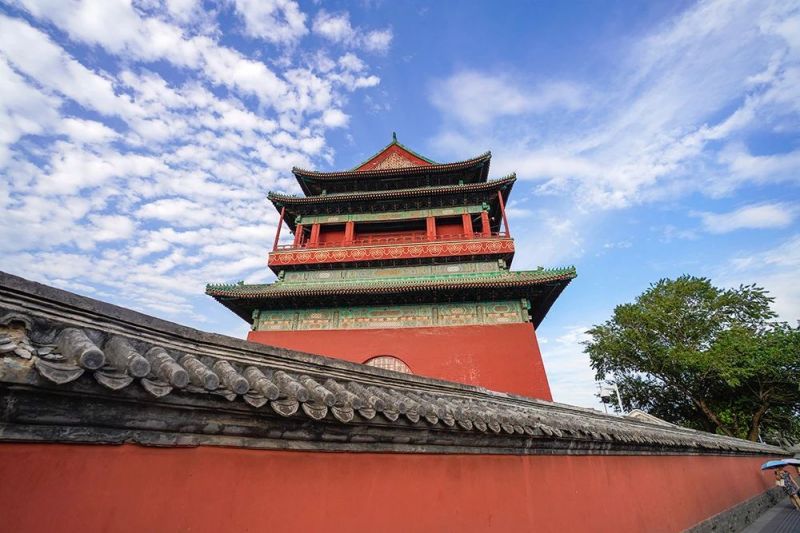
The Drum Tower (鼓楼) closes at 5:30pm, so arrive by 5pm at the latest. Consequently, climb it for a view over the hutong rooftops — the best available perspective on how the grid system looks from above, with grey tile roofs stretching in all directions. After the tower, moreover, the lanes immediately east and west of Gulou Dong Dajie are excellent for an early evening walk. Dinner: Look for jiachangcai (家常菜) signs around Mao’er Hutong and order braised pork belly (红烧肉) or dry-fried green beans (干煸四季豆).
Photo Credit:Dongcheng District People’s Government of Beijing Municipality,A view of Bell Tower Square from the Drum Tower
Route 2: The Imperial History Beijing Hutong Itinerary
This beijing hutong itinerary suits travellers who want to understand what these lanes were, who lived in them, and why the architecture looks the way it does. In total, the walking distance is approximately 5 kilometres. Allow 8–9 hours including heritage site visits.
Morning: Yonghegong and Guozijian Street (9:00–12:00)
Getting there: Yonghegong station, Lines 2 and 5, Exit C. The Lama Temple entrance is immediately outside.
Photo Credit:Beijing Municipal Government, Yonghegong
Begin at Yonghegong Lama Temple (雍和宫). It is not a hutong; nevertheless, it establishes the Qing-dynasty context that makes everything else legible. The main halls follow the same hierarchical north-south axis as a siheyuan courtyard house, scaled to imperial proportions. Allow 45 minutes. Then, walk five minutes west to Guozijian Street.
Guozijian Street is Beijing’s only surviving hutong named for an imperial institution — the National Academy that trained China’s civil service for six centuries. As a result, four stone pailou gateways still mark both ends. Moreover, the double row of scholar trees (槐树) lining the street provides, in late April, the finest urban blossom walk in Beijing.
Therefore, spend at least 90 minutes at the Confucius Temple (孔庙) and Imperial Academy Museum (国子监博物館)[2]. In the Confucius Temple courtyard, 198 stone steles record the names of 51,624 successful examination candidates — the most complete archive of China’s meritocratic bureaucracy anywhere in the world. The Imperial Academy’s painted ceiling and marble balustrades, furthermore, give a sense of institutional prestige that no photograph fully communicates.
Midday: Maoer Hutong (12:00–14:00)
Getting there: 15-minute walk south from Guozijian Street, then right into Maoer Hutong.
Photo Credit:Visitbeijing,Maoer Hutong
Lunch first: Stop at one of the small restaurants on Andingmen Inner Street before entering Maoer Hutong. The food that Beijing hutong residents actually order — zhajiang mian, guotie, and the etiquette of eating at street pace — is covered in full in our local experience guide. Order guotie (锅贴, pan-fried dumplings) or wonton soup (馄饨). Indeed, eating at street pace — standing or on a low stool — is correct for this kind of lunch.
Maoer Hutong is, architecturally, one of the best-preserved Qing-era residential lanes in Beijing’s inner city. Walk its full length east to west. First, at No. 35, look for the gate that was the childhood home of Empress Wanrong — the last Empress of China — before her selection in 1922. At No. 45, a few doors further along, stands the courtyard from which her wedding procession departed on 1 December 1922.
As you walk, read the gates. The drum-stone door piers identify household rank. Additionally, carved lintels carry bat (luck), fish (abundance), and pomegranate (fertility) motifs. Taken together, Maoer Hutong is therefore an outdoor museum of Qing residential architecture that costs nothing to enter.
Afternoon: Shichahai Lakes and Yandai Xiejie (14:00–17:30)
Getting there: 10-minute walk west from the end of Maoer Hutong to the Silver Ingot Bridge (银锭桥) between Qianhai and Houhai lakes.
Photo Credit:Visitbeijing,Yandai Xiejie
Walk the north bank of Houhai from east to west. Indeed, on a weekday afternoon, locals set up chess boards along the water and elderly residents walk with their birds. Furthermore, at the western end of Houhai, turn south into Yandai Xiejie (烟袋斜街) — Tobacco Pipe Street. This is one of Beijing’s oldest surviving commercial lanes, dating to the Ming dynasty. It takes ten minutes to walk end to end and thirty to walk it properly.
From Yandai Xiejie, finally, walk five minutes to Prince Gong’s Mansion (恭王府)[3]. Indeed, it is the largest surviving Qing private residence in Beijing, with eleven courtyards and a garden containing a full-scale Suzhou rockery. Book in advance via WeChat. Allow 75 minutes. The mansion makes concrete everything that the Maoer Hutong gates only implied: this is what Qing aristocratic domestic life looked like at its most elaborate scale.
Photo Credit:Prince Kung’s Palace Museum
Evening: Houhai Lakeside (17:30–20:00)
After Prince Gong’s Mansion, therefore, return to the north bank of Houhai for the evening. The light at this hour turns the willows gold and the water silver. Instead, choose one of the quieter establishments on the north bank (Beiyan) that face the water — avoid the main bar street on the south bank (Nanyan), which is tourist-oriented. Dinner: Siji Minfu (四季民福) near Nanluoguxiang serves properly lacquered Peking duck without a two-hour wait. Alternatively, kaoya juan (烤鸭卷) duck rolls from smaller hutong restaurants near Houhai are a lighter, faster version of the same tradition.
Practical Information for Both Routes
Both routes work best on weekdays. Weekend mornings, however, bring significantly more visitors to Nanluoguxiang, Wudaoying, and the Shichahai area. The heritage sites — Confucius Temple, Guozijian, Prince Gong’s Mansion — are equally manageable on weekends if you arrive at opening time.
Comfortable walking shoes are essential. Indeed, both routes cover 4–5 kilometres on uneven flagstone surfaces. Furthermore, a light day bag is useful for purchases on the Art Route. Similarly, the best season for both routes is late April to early May or mid-October. For full seasonal guidance, see our seasonal guide to Beijing hutong visits.
What is the best Beijing hutong itinerary for one day?
The best single-day Beijing hutong itinerary depends on your interests. For creative culture, the Art Route covers Nanluoguxiang side alleys, Fangjia Hutong, Wudaoying, and the Gulou area. If history is your focus, the Imperial History Route covers Yonghegong, Guozijian Street, Maoer Hutong, Shichahai, and Prince Gong’s Mansion. Both routes take 8–9 hours and are designed to be walked in full.
How do I get around Beijing hutongs by public transport?
All major hutong areas are accessible by subway. Line 6 serves Nanluoguxiang directly. Lines 2 and 5 serve Yonghegong, which is the starting point for Wudaoying and Guozijian Street. Beihai North (Line 6) is the closest station to Shichahai. Between stops, walking is therefore faster and more interesting than any other transport option.
How long does a hutong day trip in Beijing take? A well-planned hutong day trip takes 8–9 hours including meals and heritage sites. The main areas can be walked in 3–4 hours, but the hutong experience rewards slowing down. A rushed visit misses the detail that makes these lanes worth visiting.
What should I eat on a hutong walk in Beijing?
On the Art Route, look for home-cooking restaurants (家常菜) in Fangjia Hutong. On the History Route, pan-fried dumplings (锅贴) near Maoer Hutong and Peking duck near Houhai are the local standards. In both cases, avoid restaurants with English photo menus at the entrance — they are aimed at tourists and priced accordingly.
Is it possible to do both hutong routes in one day? Not comfortably. Together, the two routes total around 9 kilometres plus 3–4 hours of heritage site visits. Split them across two days, or choose one route and do it properly.
Planning a hutong visit? Whether you need a personalised itinerary, local recommendations, or help arranging your Beijing trip, we’d love to hear from you. Email us at hello@jollyeast.com and we’ll get back to you within 24 hours.
Best Time to Visit Beijing Hutongs: Spring Blossoms vs Autumn Gold
Choosing the best time to visit a Beijing hutong depends on what you want to feel. Spring brings blossoms and cool mornings. Autumn delivers gold leaves and roasted chestnut smoke drifting down narrow lanes. Indeed, both seasons transform the hutongs into something photographs cannot capture — and both reward visitors who know exactly what to look for.
Quick Summary
The best time to visit Beijing’s hutongs is late April to early May (scholar tree blossoms, cool mornings, spring light) or mid-October (ginkgo gold, chestnut vendors, autumn atmosphere). Both seasons offer comfortable temperatures and strong sensory character.
This guide explains what each season looks, smells, and sounds like inside the hutong lanes. For the cultural rhythms that shape the hutong calendar — what residents are doing in their courtyards at each time of year — see the complete guide to Beijing hutong culture. It therefore also gives you the specific weeks when each experience peaks.
Why Season Matters More in the Hutongs Than Elsewhere in Beijing
The Forbidden City and the Great Wall are largely season-neutral — impressive in winter, impressive in summer. The hutongs are different. In fact, their character is inseparable from the plants growing over their walls, the food cooked on the street, and the way light falls through tree canopies onto grey stone. Without trees and seasonal rhythms, a hutong is just a narrow alley. With them, however, it is something else entirely.
The hutong trees matter especially. Scholar trees (槐树, huái shù) line Guozijian Street and scatter cream-coloured blossoms in late April. Ginkgos (银杏, yínxìng) turn the lanes around Nanluoguxiang a deep yellow in mid-October. Pomegranate trees (石榴树, shíliú shù) show red fruit through open gates from September onward — planted for centuries as symbols of family abundance. None of this appears in an itinerary. Yet all of it is the experience.
Photo Credit:Beijing Municipal Commission of Urban Management,Guozijian Street
Best Time to Visit Beijing Hutong in Spring (Late March to Mid-May)
Spring arrives in Beijing’s hutongs in stages. Late March brings the first visible colour after winter: the willow trees along Houhai lake turning pale green. Moreover, scholar trees on Guozijian Street follow in mid-April, their small white flowers falling onto the flagstones and filling the air with a faint honey scent. Furthermore, Scholar trees lining many residential lanes join them by early May, carrying their scent on cool mornings before the traffic noise builds.
April offers the best hutong light of the year. At this low angle, the sun has not yet risen high enough to bleach colour from the grey tiles and brick. As a result, long shadows give every gate and courtyard wall a sculptural quality. Therefore, photographers who know Beijing plan their hutong shoots for April mornings.
What Spring in the Hutongs Feels Like
On a weekday morning in late April, the hutong sounds are layered. Brooms scrape flagstones. Meanwhile, coal briquette deliveries arrive by tricycle. At the same time, a birdcage hangs from a nearby branch, and the thrush inside sings in response to the outdoor birds. In addition, residents hang winter quilts over courtyard walls to air in the sun — an act so routine it becomes part of the visual texture of the lanes.
Photo credit: Beijing Municipal Government,Birdcages in the hutongs
Children are back outside after winter. Similarly, elderly neighbours have reclaimed their doorstep chairs. Noticeably, the pace slows compared to the colder months, and the lanes feel inhabited rather than merely occupied.
Spring Events Near the Hutongs
Two events are worth timing a visit around. The Jingshan Park peony festival runs from late April to early May, a ten-minute walk from Nanluoguxiang — therefore well worth combining with a hutong walk. Additionally, the Ditan Park spring temple fair, near Guozijian Street, typically runs across the Labour Day holiday (around 1 May) with food stalls, folk performances, and the kind of crowd that makes early arrival essential.
Peak weeks: 20 April – 10 May. Scholar tree blossoms peak around 25–30 April.
Best Time to Visit Beijing Hutong in Autumn (Late September to Mid-November)
Autumn is the season most long-term Beijing residents cite as their favourite for hutong walking. Summer crowds have dispersed. The heat has lifted. Furthermore, air quality — which can be poor in July and August — typically improves with the arrival of northern winds in October. Most importantly, the trees have begun their most dramatic transformation of the year.
Ginkgo trees are the centrepiece. Indeed, Beijing has tens of thousands of them. For instance, the hutong districts contain some of the oldest, planted along Guozijian Street and the Shichahai lanes during the Ming and Qing dynasties. By mid-October, their fan-shaped leaves turn from green to a saturated, almost luminous yellow. When the wind blows, moreover, the leaves fall all at once, carpeting the flagstones with gold. Consequently, the smell of fallen ginkgo leaves — earthy, slightly sweet and entirely distinctive — stays with visitors long after they return home.
What Autumn in the Hutongs Feels Like
Notably, street food shifts in autumn — and if you want to experience these seasonal rituals the way locals do, living hutong life rather than just sightseeing shows you explains exactly how. Chestnut vendors appear in late September — charcoal braziers with blackened pans of sugar-roasted chestnuts (糖炒栗子, táng chǎo lìzi), the smoke and caramel smell drifting down lanes for thirty metres. Pomegranates also split open on branches, their red seeds visible through courtyard gates. Furthermore, sweet potato vendors arrive with oil-drum ovens, the smell of roasting sweet potato mixing with coal smoke on cooler evenings.
Furthermore, the quality of autumn light differs from spring: lower, warmer, and more golden. Afternoon light on grey tile roofs in October has a warmth that photographers describe as impossible to replicate artificially. As a result, shadows lengthen earlier, and the lanes empty after 5pm faster than in summer, giving the hutongs a quality of late-day stillness that feels genuinely different from busier months.
Photo Credit:Sohu,Autumn in the hutongs
Autumn Events Near the Hutongs
The Beihai Park[2] chrysanthemum exhibition typically runs through October — thousands of chrysanthemum varieties around the lake and White Dagoba, a ten-minute walk from Nanluoguxiang. In addition, the Confucius Temple birthday ceremony at Guozijian Street, observed on 28 September every year, involves ritual music, costumed performers, and an atmosphere that standard sightseeing does not provide[1].
Peak weeks: 10–30 October. Ginkgo colour peaks around 15–20 October. The National Day holiday (1–7 October) brings significant crowds — wait until the second week of October for the best combination of colour and manageable visitor numbers.
What About Summer and Winter?
Beyond spring and autumn, summer (June to August) has its own character. Morning glory vines (牵牛花, qiānniú huā) climb over grey walls in purple and blue. However, July and August bring Beijing’s rainy season and hottest temperatures. That said, if you visit in summer, go before 8am or after 7pm, when residents bring chairs outside and the lanes take on a neighbourhood party quality.
Photo credit: Beijing Municipal Government,Vibrant life in the hutongs
Similarly, winter (December to February) is the quietest time in the hutongs. Fewer tourists, a slower pace, and bare branches reveal rooflines and gate structures that foliage hides in other seasons. After a light snow, the hutongs are therefore genuinely beautiful in a stripped-back way. The trade-off is cold temperatures and the absence of the outdoor social life that defines the hutong experience in warmer months.
Practical Tips for Seasonal Hutong Visits
Whatever season you choose, the hutong experience improves with timing. The lanes are quietest before 9am in any season. Tour groups, however, typically arrive after 10am. Moreover, in autumn and spring, the best light falls in the two hours after sunrise and the hour before sunset.
Finally, dress for the surface underfoot: hutong flagstones are uneven and can be slippery after rain or frost. Flat, comfortable shoes matter year-round — particularly in spring when flagstones are often damp from morning dew.
What is the best time to visit Beijing hutongs? The best time to visit Beijing’s hutongs is late April to early May (scholar tree blossoms, cool mornings) or mid-October (ginkgo gold, chestnut vendors). Both offer comfortable temperatures and strong seasonal character. Avoid Labour Day (1–5 May) and National Day (1–7 October) for quieter lanes.
When do the ginkgo trees turn yellow in Beijing’s hutongs?
Ginkgo trees in Beijing’s hutong districts typically peak in colour around 15–20 October, though the exact timing shifts by a week or two depending on the year’s weather. Guozijian Street and the lanes around Shichahai have some of the oldest and most impressive ginkgo trees in the inner city.
Is summer a good time to visit the hutongs?
Summer is possible but requires careful timing. July and August bring heat and humidity to Beijing’s narrow lanes. The best summer hutong experience comes from early morning visits before 8am, or evenings after 7pm when residents bring chairs outside.
Are the hutongs crowded in autumn? The National Day holiday (1–7 October) brings heavy crowds to popular hutong areas. For the best autumn colour with manageable visitor numbers, visit during the second or third week of October.
What seasonal food can I find in Beijing’s hutongs?
Autumn brings sugar-roasted chestnuts (糖炒栗子) and roasted sweet potatoes. Spring brings fresh seasonal vegetables at neighbourhood markets and outdoor breakfast stalls. Each season has its own street food character, and hutong food is one of the best reasons to visit at any time of year.
Planning a hutong visit? Whether you need a personalised itinerary, local recommendations, or help arranging your Beijing trip, we’d love to hear from you. Email us at hello@jollyeast.com and we’ll get back to you within 24 hours.
The Best Hutongs in Beijing: 6 Neighbourhoods Beyond Nanluoguxiang
Nanluoguxiang gets the crowds. It earns them, too — the Yuan-dynasty grid, the side alleys, the energy. However, Beijing has dozens of hutong neighbourhoods, and the best hutongs in Beijing are not always the most visited ones. Some are quieter. Some are stranger. Others are so completely themselves that walking in feels like arriving somewhere not made for you.
Quick Summary
The six best hutong neighbourhoods beyond Nanluoguxiang are: Shichahai (lakeside atmosphere), Wudaoying (independent shops and craft beer), Guozijian Street (imperial academy and scholar trees), Yangmeizhu Xiejie (books and creative culture), Maoer Hutong’s side alleys (Qing architecture), and Dongjiaomin Xiang (colonial-era buildings). All are accessible by Beijing subway.
This guide covers six hutong neighbourhoods. Each entry covers what makes it distinct, what to do there, and when to go. Nanluoguxiang appears here too, but only to point you past it. If you’re new to the hutongs, the fundamentals of Beijing hutong culture — what siheyuan courtyards are, how to read a gate, what the drum-stones mean — will make every neighbourhood below more legible.
What Makes a Hutong Neighbourhood Worth Visiting?
The best hutongs in Beijing share one quality: they have their own reason for existing. A market district, a scholarly street, a lakeside retreat, an artists’ quarter — each hutong neighbourhood grew from a specific social and economic function. Moreover, the best ones still carry traces of that original character even after centuries of change.
By contrast, the worst hutong neighbourhoods have lost that character. They have been rebuilt as stage sets: every grey wall freshly pointed, every courtyard a coffee shop. The six neighbourhoods below all sit somewhere between lived-in and over-restored. Importantly, all of them still have something the stage sets do not: actual residents going about their actual lives.
1. Shichahai (什刹海): Best Hutong Neighbourhood for First-Timers
📍 Quick info: Nearest subway: Beihai North (Line 6, Exit B) · Best for: lakeside walking, imperial history, evening atmosphere · Recommended time: 2–3 hours · Quietest: weekday mornings before 10am
If you have one afternoon in Beijing’s hutongs and no idea where to start, start at Shichahai. Three interconnected lakes — Qianhai, Houhai, and Xihai — sit at the heart of this neighbourhood. It has been Beijing’s most desirable address for over six centuries. The Yuan Dynasty used this area as the northern terminus of the Grand Canal. Subsequently, the Ming and Qing turned it into an aristocratic enclave. Today it manages to be a tourist destination, a residential neighbourhood, and one of the city’s best places to watch an evening arrive slowly.
The hutong streets around the lakes — Yandai Xiejie (烟袋斜街), Baimi Xiejie, the lanes running north from Houhai — connect silver shops, antique dealers, and courtyard cafes. Some bars here existed before bars were fashionable in Beijing. Furthermore, the pace here differs from Nanluoguxiang: slower, more lateral, with more places to sit beside the water.
Photo Credit:Visitbeijing,Yandai xiejie
What to Do at Shichahai
Walk the north bank of Houhai in the late afternoon, when the light turns gold on the willows. At that hour, locals set up chess boards along the water’s edge. Additionally, find the Silver Ingot Bridge (银锭桥) — the narrow humpback crossing between Qianhai and Houhai — and look west on a clear day. The view of the Western Hills has appeared in Chinese paintings for five centuries. For more on the area’s imperial history, see the Shichahai historical overview.
2. Nanluoguxiang and Its Eight Side Alleys (南锣鼓巷): Go Past the Main Street
📍 Quick info: Nearest subway: Nanluoguxiang (Line 6, Exit A) · Best for: Yuan-dynasty grid architecture, side-alley exploration · Recommended time: 2 hours · Quietest: weekday before 10am
Nanluoguxiang is not overrated — it genuinely ranks among the best hutongs in Beijing. What is overrated, however, is the main street itself. The 787-metre central lane is lined with snack stalls, souvenir shops, and cafes. The reason Nanluoguxiang matters is its Yuan Dynasty grid — a central spine with eight symmetrical side alleys running east-west. No neighbourhood preserves it more completely.
Those side alleys — Maoer Hutong, Yuer Hutong, Banchang Hutong, Juer Hutong, and four others — are where the neighbourhood truly lives. They are quieter and more architecturally intact than the main street. Maoer Hutong preserves some of the finest Qing-era gate architecture in the city. Carved drum-stones, layered eave brackets, and courtyard walls worn to old pewter are all here.
Photo Credit:Sohu,Juer Hutong
What to Do at Nanluoguxiang
Turn off the main street within five minutes of entering. Pick any of the eight side alleys and walk its full length. Some gates still have cylindrical drum-stone door piers indicating a former military household; others have square-based versions marking a civil official. In effect, you are reading a 300-year-old address book.
3. Wudaoying Hutong (五道营胡同): Best Hutong for Independent Shops and Craft Beer
Wudaoying runs east from the Yonghegong Lama Temple for about 800 metres. Over the past decade, it has become the go-to hutong for independent design shops, good coffee, and craft beer. The ivy-covered brick walls come without the tourist-zone intensity of Nanluoguxiang.
The hutong was a Qing-dynasty military garrison district. As a result, its relatively wide, straight alignment reflects that martial origin. What fills it today is more bohemian: independent leather workshops, pressed botanical print studios, Jing-A Taproom (one of Beijing’s original craft beer bars), and a late-Qing St Michael’s Church hidden behind a courtyard wall so inconspicuous that most visitors walk past without noticing it.
Photo Credit:Visitbeijing,Wudaoying Hutong
What to Do at Wudaoying
Walk the full length once to get your bearings, then double back to what caught your eye. The western end, closer to Yonghegong, tends to be quieter and more residential. On weekend afternoons, moreover, independent designers set up along the ivy-covered walls — leather goods, pressed plant prints, vintage pins. It is one of the best spots in Beijing for genuinely handmade souvenirs.
4. Guozijian Street (国子监街): Best Hutong for Imperial History and Architecture
Guozijian Street is the only hutong in Beijing named for an imperial institution — the Guozijian, or Imperial Academy, which served as China’s highest seat of learning from the Yuan Dynasty through the end of the Qing. It is also one of the few hutongs that retains the physical markers of its original purpose. Four stone pailou gateways still mark the entrances, with inscriptions warning that even officials had to dismount from their horses before proceeding.
The street is notably wide and straight, with a double row of scholar trees (槐树, huái shù) whose canopy closes overhead in summer. The Confucius Temple (孔庙) and the Imperial Academy Museum[1] (国子监博物館) sit side by side along the southern edge. Furthermore, the stone steles in the Confucius Temple courtyard record the names of every successful civil service examination candidates — hundreds of thousands of names carved across seven centuries. The Confucius Temple Beijing website has full visitor information, including opening hours and ticket prices.
Photo Credit:Beijing Municipal Commission of Urban Management,Guozijian Street
What to Do at Guozijian Street
Allow at least two hours for the Confucius Temple and Imperial Academy. Outside the heritage sites, the residential sections preserve some of the most intact Ming and Qing gate architecture in the inner city. Therefore, take time to look for the layered eave brackets, carved threshold stones, and screen walls (影壁, yǐngbì) visible through open gates.
5. Yangmeizhu Xiejie (杨梅竹斜街): Best Hutong for Books and Creative Culture
Yangmeizhu Xiejie runs diagonally — xiejie means “slanted street” — from the eastern end of Liulichang to the Dashilar area near Qianmen. In the Qing dynasty, this was Beijing’s “book lane”: lined with publishers, examination booksellers, and the writers who used them. That literary character survives today in altered form. Yangmeizhu now hosts Modernbook Bookstore, several design studios, and a cultural life that runs on weekend fairs rather than tourist foot traffic.
The hutong’s brick walls carry murals from a neighbourhood renewal project — geometric abstractions against grey brickwork. As a result, Yangmeizhu is one of the most photographed hutong streets in Beijing — without ever feeling designed for photography. Additionally, the hutong is a five-minute walk from Liulichang (琉璃厂), Beijing’s historic street of ink, brushes, and antique books — making the two a natural half-day itinerary.
Photo Credit:Beijing Municipal Government,Yangmeizhu Xiejie
What to Do at Yangmeizhu Xiejie
Browse Modernbook Bookstore (莫迪书店) — small and well-curated, with an English section. On Sunday afternoons from roughly 3–7pm, the street hosts a small cultural fair with woodblock print cards, illustrated postcards, and handmade candles. In short, it is the best hutong in Beijing for cultural browsing at a relaxed pace.
6. Dongjiaomin Xiang (东交民巷): Best Hutong for Architectural Curiosity
📍 Quick info: Nearest subway: Qianmen (Line 2, 5-min walk) · Best for: colonial-era architecture, quiet walking · Recommended time: 45 mins–1 hour · Best time: any weekday morning
Dongjiaomin Xiang is the longest hutong in Beijing — 1.6 kilometres end to end — and the most architecturally unusual. From the late Qing dynasty through the Republican era, this was Beijing’s foreign legation quarter. The 1900 Boxer Uprising siege of the legations took place along this street. Consequently, the buildings constructed afterwards were built in the European styles of their home countries.
What remains is a 1.6-kilometre walk through an accidental architectural museum: red-brick Neo-Gothic churches, French Beaux-Arts bank facades, and colonnaded legation buildings with shuttered windows. None of it looks remotely like Beijing. Nevertheless, all of it is in Beijing. The buildings now house courts and government offices, and the street is quiet enough to walk end to end without passing another tourist.
Dongjiaomin Xiang
What to Do at Dongjiaomin Xiang
Walk the full length — about 25 minutes at an unhurried pace — from the Qianmen end to Chang’an Avenue. Look for the Former French Legation building with its colonnaded courtyard, the Former Yokohama Specie Bank (now a legation quarter museum), and St. Michael’s Church with its twin Gothic spires. In addition, read the historical markers: several cover the 1900 events in detail that no general guidebook includes. The Beijing Legation Quarter article provides useful historical background before you visit.
Frequently Asked Questions
What are the best hutongs in Beijing?
The six most rewarding hutong neighbourhoods are Shichahai (lakeside atmosphere), Nanluoguxiang’s side alleys (Yuan-dynasty grid), Wudaoying Hutong (independent shops and craft beer), Guozijian Street (imperial history), Yangmeizhu Xiejie (books and creative culture), and Dongjiaomin Xiang (colonial-era architecture). Each suits a different kind of traveller and a different kind of visit.
Which hutong in Beijing is the most famous?
Nanluoguxiang is the most visited hutong in Beijing. For a quieter experience with equally interesting architecture, however, the eight side alleys off Nanluoguxiang — especially Maoer Hutong — offer the same Yuan-dynasty grid without the main street crowds.
Is Shichahai a hutong neighbourhood?
Shichahai refers to the three-lake district in Xicheng. The hutong neighbourhood surrounding the lakes — including Yandai Xiejie and the residential lanes to the north and east — is one of Beijing’s oldest and most atmospheric hutong areas. It is therefore one of the best hutongs in Beijing for a first visit.
How long does it take to visit a hutong neighbourhood in Beijing?
A focused walk through a single hutong neighbourhood takes 1–2 hours. Shichahai and Nanluoguxiang reward half-day visits if you include the side alleys. Dongjiaomin Xiang can be walked end-to-end in 25 minutes, though the architecture warrants a slower pace.
Are Beijing’s hutong neighbourhoods safe for tourists?
Yes. Beijing’s hutong areas are among the safest neighbourhoods in the city for walking. The main hazard is electric scooters moving quietly through narrow lanes — step to the side when you hear one behind you.
What is the best time of year to visit Beijing’s hutongs? Spring (April–May) and autumn (September–October) offer the best weather and most striking scenery. Spring brings locust and scholar tree blossoms to Guozijian Street; autumn turns the plane trees of Dongjiaomin Xiang golden. For a full seasonal guide, see our article on Best Time to Visit Beijing Hutongs.
Planning a hutong visit? Whether you need a personalised itinerary, local recommendations, or help arranging your Beijing trip, we’d love to hear from you. Email us at hello@jollyeast.com and we’ll get back to you within 24 hours.
Beijing hutongs have a history of over 700 years, rooted in a deliberate urban creation. To understand what these lanes became culturally, the guide to Beijing hutong culture explores the social life, architecture, and etiquette that evolved from this historical foundation. In 1267, Kublai Khan chose a burned Jurchen capital as the site for his new world. What remained of the old city was ash and foundation stones. From that scorched ground, he built Khanbaliq — the City of the Khan — which would become the Beijing we know today. With it came the hutong: the narrow residential lanes that would carry the pulse of the city across seven dynasties and into the present.
Quick Summary
Beijing’s hutongs originated in the Yuan Dynasty (1271–1368) when Kublai Khan laid out Khanbaliq on a strict grid. The Ming Dynasty codified them into a social hierarchy; the Qing divided them by ethnicity. Over 5,000 hutongs were demolished in the 20th century. Fewer than 1,500 survived by 2003, and Beijing’s 2016–2035 Urban Master Plan now protects what remains.
Beijing Hutong History Begins: The Yuan Blueprint
The Yuan Dynasty (1271–1368) planned Khanbaliq on a strict cardinal grid: avenues running north-south, lanes running east-west, the imperial palace at the exact centre. It was a city designed to communicate power through geometry. Every road, every courtyard, every gate aligned to project the idea of an ordered universe with the emperor at its heart.
Between the grand avenues, planners carved a dense network of narrow residential lanes. These were the first hutongs.
The word itself is Mongolian in origin. Scholars trace it to hottog, meaning a cluster of gers (the round felt tents of the Mongolian steppe) gathered around a shared water source. In the new capital, the shared water source became the communal well, and the lanes leading to it became the hutongs. Every neighbourhood organised around one. Residents drew water each morning, exchanged news, and returned to their courtyard homes.
Marco Polo visited Khanbaliq during this period and described a city of remarkable order: straight streets, gates that locked at night, and a population living behind walls in ways he found simultaneously familiar and foreign. He was, without knowing the word, describing the hutong system.
Historical records from the Yuan court mention ‘sān bǎi bā shí sì huǒ xiàng’ — officially referred to as 384 fire lanes — as the official count of the city’s residential passages. The term “fire lane” reflects a practical concern: in a city of densely packed wooden structures, lanes needed to be wide enough to stop fire jumping between compounds, and to allow bucket brigades to move freely. In 13th-century Beijing, urban planning and fire prevention were the same discipline.
Photo Credit:Toutiao,Beijing Hutong old photo
The Ming Transformation: Rank Written in Brick
After the Yuan Dynasty, the Ming Dynasty (1368–1644) inherited and reshaped the hutong system, infusing it with distinct Chinese social order.
The Ming rebuilt the capital walls and repositioned the imperial palace slightly southward. Most importantly, they codified the siheyuan (四合院) — the courtyard house — as the standard residential unit for the elite. What had been a practical building form under the Yuan became, under the Ming, architectural law.
The Siheyuan Code: Status in Stone and Timber
A senior official’s compound could have multiple courtyards nested one behind the other. A minor official’s residence warranted only one. A merchant, however wealthy, faced restrictions on gate height and eave decoration. The Ministry of Rites enforced these rules, treating architecture as a branch of social order.
A household’s position within the hutong network became a status marker. Lanes closest to the imperial palace — in today’s Dongcheng and Xicheng districts — were reserved for princes, senior officials, and imperial family members. The further a hutong lay from the palace walls, the lower the resident’s rank. The city was a map of hierarchy, readable from above.
This period gave many hutongs their names. Some took the trades practiced in them: Lantern-Maker Lane, Bronze-Caster Lane, Bow-and-Arrow Lane. Others recorded natural features since paved over: Willow Tree Lane, Stone Well Lane. Liulichang (琉璃厂) — which became Beijing’s great street of scholars and antique dealers — dates to this era, established to house workers who made glazed tiles for the imperial palace.
The Qing Dynasty: A City Divided, a Culture Doubled
When the Manchu Qing Dynasty (1644–1912) took Beijing, they made a decision that reshaped the hutong world permanently.
The inner city — within the original Yuan and Ming walls — was reserved for Manchu bannermen and their families. Han Chinese residents relocated to the outer city, south of Qianmen Gate. Beijing became a physically divided capital almost overnight: Manchu north, Han south.
Two Hutong Worlds Running in Parallel
The inner city hutongs around Shichahai and the Drum Tower became the preserve of Qing aristocracy. Prince Gong’s Mansion (恭王府)[1], the largest private residence surviving from this period, stands in Xicheng District today as a monument to that concentrated wealth: eleven courtyards, a private garden with a full-scale Suzhou rockery, and enough rooms to run an administrative apparatus. The Palace Museum holds extensive records of Qing residential architecture from this era[2].
Photo Credit:People’s Government of Dongcheng District, Beijing,The current Gulou area
The outer city hutongs grew differently — denser, more commercial, more mixed. Dazhalan (大栅栏), the great market street near Qianmen, became a labyrinth of shops, teahouses, and performance venues. Beijing opera found its first permanent home there, performed for Han merchants and craftspeople who built a prosperous world in the shadow of an imperial city they were forbidden to inhabit.
By the late Qing, Beijing’s hutong network reached several thousand lanes. Each had its own micro-economy and social character. A traveller who knew the city could read a hutong’s history in the width of its lanes (broader in the inner city, narrower in the outer), the decoration of its gates (carved lintels for officials, plain brick for tradespeople), and the sounds from its walls (bird calls and chess in the aristocratic north, workshop clatter and street vendors in the mercantile south).
The Republic Era: Noble Compounds Become Crowded Courtyards
The fall of the Qing in 1912 began the process of unsealing the hutongs.
Bannermen who had lived in inner city hutongs for three centuries lost their stipends. Compounds that once housed single noble families were subdivided, sold, and rented to whoever could pay. The great Beijing courtyard houses — designed for one extended family — filled with multiple unrelated households, each occupying a wing or single room of what had been a unified domestic world.
With this subdivision, the dazayuan (大杂院) — the ‘big messy courtyard’ — was born. A single family’s private garden became a shared courtyard crowded with lean-to kitchens against ancient walls, coal sheds where pomegranate trees once stood, and laundry strung between carved columns of a reception hall.
Writers Who Captured the Hutong in Transition
Republican-era writers came to the hutongs precisely because they were changing. Lao She, Beijing’s great chronicler, set much of his work in these lanes. Rickshaw Boy (骆驼祥子) follows its protagonist through a Beijing of narrow alleys, shared wells, and the grinding economics of hutong poverty. Zhang Henshui wrote serial novels from Zhuanta Hutong (砖塔胡同). Lu Xun spent years in Beijing’s hutong neighbourhoods, writing with the sounds of the lanes audible through his study window. Their work preserves the sensory texture of hutong history that no official record captures.
Photo Credit:Beijing Municipal People’s Government,Lao She’s Former Residence
Twentieth-Century Demolition: The Hutong Under Threat
The People’s Republic brought a new urban ideology, and for Beijing hutong history, it was the most damaging chapter yet.
From the 1950s onward, planners demolished Beijing’s ancient lanes to build Soviet-influenced boulevards, work-unit housing blocks, and modern infrastructure. Chang’an Avenue — the great east-west axis past Tiananmen Square — consumed entire hutong neighbourhoods. Government ministry expansions cleared more. By the 1980s, the scale of loss had become visible even to planners who had approved the demolitions.
The 1990s real estate boom accelerated the destruction. Between 1990 and 2003, Beijing lost more hutongs than in all preceding decades combined. Long-established residents relocated to apartment blocks on the outer ring roads. The courtyards they left behind either came down or converted into bars, boutique hotels, and restaurants serving tourists who came to see what little remained.
Beijing Hutong History Today: Protection and a New Kind of Pressure
The Beijing Urban Master Plan (2016–2035) designated surviving hutongs as protected heritage. Demolition was prohibited and renovation required the preservation of traditional architectural forms. It was a significant shift, arriving later than it should have.
Protection did not mean freezing the hutongs in amber. Instead, the lanes that survived the bulldozers faced gentrification. Courtyard houses in Nanluoguxiang (南锣鼓巷) and Shichahai converted into boutique hotels and restaurants. Property values in the inner hutong zones rose past what the residents who defined the culture could afford.
Photo Credit:Beijing Municipal Commission of Urban Management,The current Nanluoguxiang area
Yet the hutongs did not become museums. In the quieter lanes — Wudaoying Hutong, the side alleys off Maoer Hutong, the stretches of Guozijian Street tourists walk past without stopping — people still live as Beijingers have lived for centuries. Courtyards, grey brick walls, neighbours who know each other by name.
Zhuanta Hutong (砖塔胡同) in Xicheng District — the oldest surviving hutong in Beijing — carries this continuity most vividly. The Yuan-era brick pagoda (built around 1228 for the monk Wansong Laoren) still stands at its western end. Lu Xun lived here. Zhang Henshui wrote novels here. Today, residents hang laundry from bamboo poles a few metres from a 700-year-old monument. The scene the hutong made possible for Kublai Khan’s subjects, it makes possible still. To understand Beijing hutong history is to recognize that the city’s past is not confined to glass cases — it lives on, hanging out to dry in the afternoon sun.
How old are Beijing’s hutongs? Beijing’s hutongs are over 700 years old. The system dates to the Yuan Dynasty (1271–1368). Zhuanta Hutong in Xicheng District is the oldest surviving example, continuously inhabited since the Yuan era.
How many hutongs are there in Beijing today? Fewer than 1,500 traditional hutongs survived as of 2003.
Why were so many hutongs demolished? More than 5,000 hutongs were lost in two waves: Soviet-influenced urban planning in the 1950s–70s, and the real estate boom of the 1990s–2000s.
What is the oldest hutong in Beijing? Zhuanta Hutong (砖塔胡同) in Xicheng District is the oldest surviving hutong. It takes its name from a Yuan Dynasty brick pagoda built around 1228, which still stands at its western end.
What dynasty built the hutong system? The Yuan Dynasty (1271–1368) established the hutong network as part of Kublai Khan’s planned capital Khanbaliq. The Ming (1368–1644) and Qing (1644–1912) dynasties expanded and refined the system over the following centuries.
What does “hutong” mean? The word comes from Mongolian hottog, meaning a cluster of dwellings around a shared water source. In Yuan-dynasty Beijing, that water source was the communal well at the heart of each neighbourhood.
Planning a hutong visit? Whether you need a personalised itinerary, local recommendations, or help arranging your Beijing trip, we’d love to hear from you. hello@jollyeast.com and we’ll get back to you within 24 hours.
Beijing Hutong Culture: A Complete Guide for First-Time Visitors
The Forbidden City tells you how emperors lived. The hutongs tell you how Beijing lives.
This guide covers everything a first-time visitor needs to understand Beijing hutong culture — what hutongs are, where they came from, what you’ll actually find inside them, and how to move through them without missing the point.
What Is a Hutong? Understanding Beijing Hutong Culture at a Glance
Technically, a hutong (胡同) is a narrow lane or alley formed by the outer walls of traditional courtyard homes. That’s the dictionary answer, and it’s almost useless.
The more honest answer: a hutong is a neighbourhood compressed into an alleyway. It’s the width of two bicycles, the height of a single storey, and it contains within it — in the space of a few hundred metres — everything a community needs to function: a breakfast stall, a hardware shop, an elderly man’s chess board set up on a folding table, a communal vegetable plot squeezed into a doorway, two cats asleep in the sun.
Photo credit: Baike.so, Old Beijing Hutongs
The word itself comes from Mongolian — hottog, meaning “water well.” During the Yuan Dynasty (1271–1368), when Kublai Khan rebuilt Beijing as his capital, neighbourhoods organised themselves around shared wells. The lanes between them became the hutongs. The word stuck through every dynasty that followed.If you want to go deeper into the social history behind these lanes, our Beijing Hutong History article covers 700 years in detail.
What makes Beijing hutong culture distinct from a typical city neighbourhood is the physical form of the homes that line them: the siheyuan (四合院), or courtyard house.
The Siheyuan: The Architectural Heart of Beijing Hutong Culture
To understand Beijing hutong culture, you need to understand what’s behind the walls.
A siheyuan — literally “four-sided courtyard” — is a home arranged around a central open-air courtyard. Four buildings face inward: the main hall to the north (the most prestigious position, reserved for the senior generation), side rooms to east and west, and a gatehouse to the south. Everything faces the centre. The sky above the courtyard is a perfect rectangle.
This layout is not accidental. It encodes the Confucian values that shaped Chinese society for centuries: hierarchy (north is senior, south is junior), harmony (all parts face the shared centre), and the relationship between human beings and the natural world. The concept has a name: tiānrén héyī (天人合一) — heaven and humanity in harmony.
Photo credit: Beijing Municipal Government, Traditional Dwellings—Old Beijing Siheyuan
How to Read a Hutong Gate Before You Even Enter
The gate itself is a text, if you know how to read it.
The drum-stones flanking the entrance (called mèndāng shí, 门当石) indicate the original household’s rank. Cylindrical drum-shaped stones signal a military household. Square-based stones signal a civil official. The higher the relief carving, the higher the rank.
Photo credit: sina.com mèndāng shí
Above the gate, look for the door lintel (hùdui, 户对) — pairs of cylindrical protrusions. Count them: a senior official’s gate had six; a minor official’s had four; a merchant’s gate had two. This system of stone codes was so widely understood in imperial China that it gave rise to the expression mén dāng hù duì (门当户对) — “matched gates and lintels” — which still means “a good match” in modern Mandarin, used today about marriage.
Step through the gate and you’ll encounter the yǐngbì (影壁) — a decorative screen wall that blocks the direct line of sight into the courtyard. Its function is partly spiritual (deflecting bad energy that travels in straight lines) and partly practical (preserving privacy from the street). Look for carvings of bats (fú, 蝠 — a homophone for luck), fish (abundance), and pomegranates (fertility and family prosperity).
The Threshold Rule: Essential Beijing Hutong Culture Etiquette
Never step on the threshold (门槛, ménjǐn). Step over it. This is one of the non-negotiable rules of hutong etiquette, and it carries real weight for older residents. The threshold is the boundary between public and private space. In a culture where home is deeply tied to family identity and ancestral continuity, it matters.
The Living Culture of Beijing’s Hutongs
What makes Beijing hutong culture different from a heritage site is that people still live in it. These are not museum streets. They are working neighbourhoods, with all the texture and friction that implies.
The Sound of a Hutong Morning
The hutong morning has a soundtrack unlike anything else in Beijing. Before 7am, before the tourist rickshaws and the coffee shops open, the lanes belong to the people who actually live there.
By 6am, the elderly residents are out. Some carry birdcages — letting their thrushes and larks sing in the cool air is a daily ritual that has no English equivalent. Others move through the slow arcs of tai chi. A vendor cycles through with a cart of fresh doufu, calling out in a flat Beijinger’s drawl. Someone’s coal briquette delivery is being stacked against a courtyard wall.
This is Beijing hutong culture at its most undiluted: communal, unhurried, built around relationships rather than transactions.
Photo credit: Beijing Municipal Government, Birdcages in the Hutongs
The Language of Hutong Neighbourliness
The most famous hutong greeting is “Chī fàn le ma?” (吃饭了吗?) — “Have you eaten yet?” To a visitor, it sounds like a question about food. To a Beijinger, it means something closer to I see you. You matter. It’s the hutong equivalent of “how are you,” except it carries the weight of a culture in which feeding people is one of the most fundamental expressions of care.
This kind of communal warmth — neighbours borrowing vinegar across a wall, calling to each other through open gates — is what Beijingers mean when they talk about hútong jīngshén (胡同精神): hutong spirit. It’s a sense of shared life that high-rise apartment culture has largely eroded, and it’s the reason many older Beijingers, despite the cramped conditions and shared facilities of many hutong homes, speak of their lanes with a nostalgia that has nothing to do with aesthetics.
The Best Areas to Experience Beijing Hutong Culture
Not all hutongs offer the same experience. Here’s a brief orientation to the best areas for first-time visitors exploring Beijing hutong culture:
Shichahai area (什刹海): The most atmospheric introduction for first-timers. Three interconnected lakes — Qianhai, Houhai, and Xihai — are linked by lanes including Yandai Xiejie and Baimic Xiejie. This area was an imperial canal terminus in the Yuan Dynasty and a noble retreat in the Ming and Qing. Today it retains a genuinely mixed character: elderly residents alongside bars and antique shops.
Photo credit: Visitbeijing, Yandai Xiejie
Nanluoguxiang (南锣鼓巷) and its eight side alleys: The most-visited hutong in Beijing, and for good reason — it preserves the Yuan Dynasty grid layout better than almost anywhere else in the city. The main street is busy; the side alleys (Maoer Hutong, Yuer Hutong) are quieter and more residential. Visit on a weekday morning to see it before the crowds.
Wudaoying Hutong (五道营胡同): The best hutong for a slower, more contemporary experience — independent design studios, craft beer, ivy-covered walls, and a significantly lower tourist density than Nanluoguxiang.
Guozijian Street (国子监街): Beijing’s only remaining hutong named for an imperial institution[2] — the National Academy, China’s highest seat of learning for centuries. Ming dynasty pailou gateways still mark both ends. This is the hutong for history and architecture.
Liulichang (琉璃厂): The cultural street of ink, brushes, and antique books — occupied by the same trade since the Qing court’s craftsmen settled here. The calligraphy shops and rare-book dealers give this hutong a distinct smell: ink and aged paper.
Cultural Dos and Don’ts for Visiting Beijing Hutong Culture Sites
Hutongs are living neighbourhoods. These aren’t rules for a museum; they’re the norms of a community.
Do ask before photographing people. Say: “Nín hǐo, wǒ kěyǐ pāi zhāng zhàopiàn ma?” (您好,我可以拍张照片吗?) — “Hello, may I take a photograph?” If they decline, smile and say “Bù hǐo yìsi dǎrǐo nín le!” (不好意思打扰您了!) — “Sorry to disturb you.” The photography reflex is the single fastest way to break the warmth of a hutong encounter.
Don’t step on the threshold. Step over it, always.
Do move slowly. The hutong rhythm is not the city rhythm. Walking fast, talking loudly, and checking your phone while walking are all signals that you’re passing through rather than present. Slow down.
Do look up and in. The most interesting things in a hutong are not on the main lane. They’re above eye level (carved lintels, crumbling ridge tiles, birds in cages hung from branches) and inside open gates (glimpsed courtyards, a grandmother shelling beans, a child doing homework).
Don’t enter courtyards without asking. A partially open gate is not an invitation. Knock, make eye contact, and ask: “Wǒ kěyǐ cānguān yīxià nín jiā de yuànzi ma?” (我可以参观一下您家的院子吗?) — “May I briefly look at your courtyard?” Most older residents in residential hutongs will say yes, and some will tell you stories that no guidebook contains.
Practical Information for Visiting Beijing’s Hutongs
Best time to visit: Arrive at a hutong before 9am for the quietest, most authentic experience. The crowds arrive with the tour groups after 10am. Spring (April–May) and autumn (September–October) offer the most beautiful light and the most comfortable temperatures.You can also read about how to experience hutong life like a local for practical tips beyond the tourist trail.
How to get around: Walk. The hutongs are 2–4 metres wide — some much narrower — and walking is the only mode of transport that lets you stop, look, and change direction freely. Shared bicycles work well for covering ground between neighbourhoods; lock up before entering any narrow lane.
Getting there: Most hutong areas are within walking distance of central Beijing subway stations. Nanluoguxiang has its own stop on Line 6. Shichahai is served by Beihai North (Line 6). Wudaoying is a five-minute walk from Yonghegong (Lines 2 and 5).
Frequently Asked Questions About Beijing Hutong Culture
What does “hutong” mean in Beijing hutong culture?
The word comes from Mongolian (hottog), meaning water well or lane. Beijing hutong culture developed in the Yuan Dynasty (13th century) as lanes between courtyard homes organised around shared wells.
Are Beijing’s hutongs safe for tourists?
Yes. Hutong neighbourhoods are among the safest areas in Beijing for walking. Traffic in the narrower lanes is minimal. The main hazard is the occasional electric scooter moving quietly and quickly — look before stepping sideways.
Can I enter a siheyuan courtyard?
Some are open to the public (Prince Gong’s Mansion, the Shijia Hutong Museum)[3]. Residential courtyards require asking permission first. Knock at a partially open gate and ask politely — many residents welcome curious visitors.
What’s the difference between a hutong and a siheyuan?
A hutong is the lane. A siheyuan is the courtyard house that lines it. You walk through a hutong; you live in a siheyuan. Both are central to understanding Beijing hutong culture.
Do I need a guide to visit Beijing’s hutongs?
Not for a general visit — the main hutong areas are well-signed and easy to navigate on foot. A local guide adds value if you want to understand the architecture and social history in depth, or if you want access to residents who don’t speak English.
How many hutongs are left in Beijing?
Estimates vary, but fewer than 1,000 traditional hutongs remain in the inner city, down from several thousand at their peak. The Beijing Urban Master Plan (2016–2035) now protects the surviving lanes from demolition[1].
Living Like a Beijinger: How to Experience Hutong Life, Not Just See It
Most visitors to Beijing’s hutongs do the same thing: they walk in, take photos of the grey brick walls and red lanterns, buy a stick of candied hawthorn, and walk out. They’ve seen the hutongs.
But they haven’t lived them.
I grew up in Beijing, and the hutongs were never a tourist attraction to me. They were, for instance, the sound of a broom scraping flagstone at 6am. The smell of coal smoke mixing with soy sauce on a winter morning. The neighbour calling across the wall: “Chī fàn le ma?” — “Have you eaten yet?” — which in hutong culture isn’t really a question about food. It’s how people say I see you. You matter.
That’s what this guide is about. Not the hutongs you photograph, but the hutongs you feel. Here’s how to step off the tourist path and into the actual rhythm of Beijing’s most living neighbourhoods. For background on the hutong system itself, see our complete guide to Beijing hutong culture.
Quick Summary
To truly experience hutong life in Beijing, join a tai chi group at dawn (6–8am), eat zhajiang noodles before noon at a local jiācháng cài restaurant, visit a residential siheyuan courtyard in the afternoon, and browse the weekend night market at Wudaoying or Yangmeizhu. Arrive early, move slowly, and speak a few words of Mandarin — that’s the difference between seeing the hutongs and living them.
Start Your Morning the Right Way: Tai Chi at Dawn
Best time: 6:00–8:00 am | Locations: Beihai Park, hutong squares near Yangmeizhu
The hutong morning has a soundtrack. Indeed, before the coffee shops open and the rickshaw tours begin, the alleys belong to the people who actually live there.
By 6 am, the elderly residents are already out. For instance, some carry birdcages, letting their thrushes sing in the cool air. Others move through the slow, deliberate arcs of tai chi — white-sleeved arms tracing circles that look like they’re rearranging something invisible in the air.
The best place to join them is Beihai Park (Exit B, Line 6, Beihai North Station — five minutes on foot). Near the White Dagoba and the pavilions of Qionghua Island[1], you will find groups of older Beijingers practising tai chi and sword dancing most mornings. Moreover, the atmosphere is unhurried and genuinely welcoming to curious outsiders.
A Tai Chi Group at Beihai Park @瑞淇0836
If you’d rather stay in the hutongs themselves, look for the small open squares near Yangmeizhu Xiejie or the courtyard of Fangjia Hutong. These are, however, quieter, more intimate — a few neighbours stretching, a radio playing Peking opera somewhere nearby.
How to Join a Tai Chi Group
When you find a group, don’t hover at the edge taking videos. Instead, walk up, smile, and say:
“Wǒ kěyǐ yīqǐ liàn ma?”“May I practise with you?”
Indeed, nine times out of ten, someone will wave you in and show you where to stand.
Insider Note: Don’t look for a sign or an organised class. In fact, real hutong tai chi doesn’t advertise. The groups that are easy to find near tourist entrances often perform for tourists. Therefore, walk two or three alleys deeper — past the breakfast stalls and the old men with their newspapers — and you’ll find the real thing. After the session ends, moreover, if someone offers you a cup of jasmine tea, accept it. Indeed, that’s not just hospitality. That’s an invitation into hutong life.
Lunch the Beijing Way: The Dishes Locals Actually Eat
Best time: 11:00am–12:30pm (hutong kitchens close early) | Locations: Fangjia Hutong, Houhai area, Nanluoguxiang side alleys
Indeed, if there’s one thing that separates a real Beijing day from a tourist Beijing day, it’s what you eat for lunch — and when.
Hutong restaurants don’t run on restaurant hours. Instead, they run on neighbourhood hours. By 12:30pm, the best spots are packed. Furthermore, by 2pm, many close entirely. Therefore, arrive hungry before noon.
Zhajiang Mian (炸酱面) — The Everyday Classic
Hand-pulled noodles, topped with a dark, savoury pork and fermented soybean sauce, then piled with julienned cucumber, bean sprouts, and celery. You mix it yourself at the table. As a result, the first chopstick-twirl releases a smell that is, without exaggeration, one of the most comforting things in Beijing.
To order, simply say:
“Lái yī wǎn zhájiàng miàn, duō jiā cài!”“One bowl of zhajiang noodles, extra vegetables!”
Find it at Hǎiwǎn Jū in Fangjia Hutong, or at any bustling jiācháng cài (home-style cooking) shop full of elderly regulars — that crowd is your quality signal.
Zhajiang Noodles at Haiwan Ju
Lǔzhǔ (卤煮) — For the Adventurous
Slow-braised pork intestine, lung, and flatbread simmered in a deeply spiced broth, finished with garlic paste and chilli oil. First, the smell hits you — rich, funky, utterly unlike anything you’ve had before. It’s an acquired taste for outsiders. However, in Beijing, this is comfort food. The kind of thing people eat on cold mornings when they want to feel like themselves.
Try it at Běixīnqiáo Lǔzhǔ near Houhai. Order a small bowl first (xiǎo wǎn, 小碗) if you’re uncertain.
Luzhu at Beixinqiao Luzhu
Dòuzhīr (豆汁儿) — The Real Test
Fermented mung bean juice. Pale grey, sharply sour, slightly fizzy on the tongue. Beijingers drink it warm, with crispy fried dough rings (jiāoquān, 焦圈) on the side.
Here’s the honest insider truth: most people from outside Beijing don’t like it. Even many younger Beijingers don’t drink it. But ordering a cup at Cíqìkǒu Dòuzhī Diàn on Nanluoguxiang and attempting it — that act alone will earn you more genuine smiles from elderly Beijingers than any other single thing you do in the city.
Furthermore, if you can’t finish it, just laugh and say: “Xià cì zài shì!” (“I’ll try again next time!”) They’ll appreciate the honesty.
A classic Beijing breakfast experience: douzhi paired with crispy jiaoqian and tangy pickled vegetables
Insider Note: Hutong lunch crowds peak at exactly 12:00–12:30pm because that’s when the neighbourhood school lets out. Children flood the alleys, grandparents come to collect them, and the small restaurants fill up in minutes. Arrive at 11:30am to eat in peace, or at 12:45pm to eat with the neighbourhood — crowded tables, loud conversations, someone’s grandmother telling you that you’re using your chopsticks wrong. Both are valid Beijing experiences.
Afternoon: Knock on the Door of a Siheyuan Courtyard
The grey brick walls of Beijing’s hutongs hide something most tourists never see: the courtyard.
From the alley, a siheyuan (四合院) looks like a closed door. Notably, a heavy wooden gate — sometimes painted red, often worn to a dull brown — has a pair of stone drum-shaped door piers on either side. Those piers are a code: cylindrical drums signal a military household; square bases signal a civil official. In other words, centuries of social hierarchy, written in stone at knee height.
Indeed, what lies behind the gate is a world arranged around stillness. Four buildings face inward onto a shared courtyard — traditionally housing different generations of the same family. In the centre: a pomegranate tree (symbolising family abundance), a stone water basin, sometimes a few potted chrysanthemums. The sky above is a perfect square. The concept underlying the whole design is tiānrén héyī — heaven and humanity in harmony.
To see inside a real residential courtyard, try Yúér Hutong or the quieter sections of Màoér Hutong. When you find a gate that’s slightly ajar — a sign that someone is home and open to the world — approach and knock gently. Then say:
Maoer Hutong
“Nín hǎo, wǒ kěyǐ cānguān yīxià nín jiā de yuànzi ma?”“Hello, may I take a brief look at your courtyard?”
Most older residents, especially those who’ve lived there for decades — will let you in. Moreover, they’re often proud of their homes and happy to talk. However, what they’re not looking for is someone who walks in silently, takes twenty photos, and leaves without a word.
What to look for inside:
The yǐngbì (影壁) — a decorative screen wall just inside the gate, which deflects bad spirits and, more practically, curious eyes from the street
Door carvings — bats (luck), fish (abundance), and pomegranates (fertility) carved into the woodwork
The threshold — never step on it. Ever. It is considered deeply disrespectful, and to older residents, it still carries real meaning.
Insider Note: Older Beijingers in the hutongs are often lonely. Their children have moved to apartments in newer districts; their grandchildren are busy. A foreign visitor who knocks politely and shows genuine curiosity is, for many of them, a genuinely welcome interruption. Above all, the key is to move slowly, ask before touching anything, and leave the space exactly as you found it. Above all, if they offer you tea, you’ve done it right.
For a less nerve-wracking introduction to courtyard architecture, Gōngwáng Fǔ (Prince Gong’s Mansion) in the Shichahai area offers a beautifully preserved Qing dynasty siheyuan — book the tour in advance[2] and don’t miss the marble xīmén pailou gateway, the acoustic opera stage, and the hùnchuāng lattice windows designed to admit light while preserving privacy.
Yin’an Hall, the main ceremonial hall of Prince Gong’s Mansion
Evening: The Night Market and the Art of Slow Shopping
Best time: Saturdays/Sundays, 4:00–8:00pm | Locations: Wǔdàoyíng Hutong, Yangmeizhu Xiejie
By late afternoon, however, the hutongs shift gear. Notably, the morning belongs to the elderly; the evening belongs to the young and creative.
Wǔdàoyíng Hutong (五道营胡同), running east from Yonghegong Lama Temple, transforms on weekends into something between a neighbourhood market and an outdoor gallery. Consequently, independent designers set up along the ivy-covered walls: handmade leather goods, pressed botanical prints, vintage enamel pins, hand-poured candles. Furthermore, the craft beer bar Jing-A is here too, if you want somewhere to sit and watch the neighbourhood go by.
Wudaoying Hutong @路克马 via Rednote
Yangmeizhu Xiejie (杨梅竹斜街) on Sunday afternoons draws a different crowd: second-hand book browsers outside Modernbook Bookstore, illustrations and Peking opera magnet art at the culture fair, hand-dipped candles and woodblock print cards.
Yangmeizhu Xiejie @嫩嫩能 via Rednote
The point isn’t just to buy things. Instead, it’s to talk to the people selling them.
Ask a designer where she studied. Find out from the bookshop owner which book he’d pick up if he were a first-time visitor to China. Additionally, ask the ceramicist how long it took to make the bowl you’re holding. Use the phrase:
“Zhège yǒu shénme gùshi?”“What’s the story behind this?”
Indeed, most vendors in these hutong markets are young Beijingers who are genuinely excited about what they make. As a result, that question unlocks a conversation you won’t have in any shopping mall.
For bargaining at the more casual stalls near Houhai‘s north bank — jewellery, vinyl records, small antiques — a friendly opener is:
“Piányí yīdiǎnr ma?”“Could you go a little lower?”
Always smile when you say it. After all, in hutong culture, negotiation is a social ritual, not a battle. For more on which hutong neighbourhoods to visit, see our guide to the best hutongs in Beijing.
FAQ: Hutong Life in Beijing
How do I join a tai chi session in Beijing’s hutongs?
Show up at Beihai Park or a hutong square near Yangmeizhu between 6 and 8am. Find a group of elderly residents and approach with a smile. Say “Wǒ kěyǐ yīqǐ liàn ma?” — “May I join?” No booking or fee needed. Most groups welcome curious visitors.
Is it okay to visit a siheyuan courtyard as a tourist?
Yes, if you ask permission first. Find a gate that’s slightly open, knock, and ask politely. Most elderly residents welcome curious visitors — they are often proud of their homes. Prince Gong’s Mansion is a fully open alternative that requires no permission. For more on what you’ll find inside, see our guide to Beijing hutong culture.
What do Beijing locals actually eat in the hutongs?
The three classics are zhajiang mian (pork noodles), lǔzhǔ (braised offal stew), and douzhir (fermented mung bean juice). Arrive before noon — hutong kitchens close early, often by 2pm. Restaurants packed with elderly regulars are the most reliable quality signal.
When is the best time of day to visit Beijing’s hutongs?
Early morning (6–9am) for tai chi and neighbourhood sounds; late morning for food; afternoon for courtyard visits; weekend evenings for the hutong markets at Wudaoying and Yangmeizhu. For the best season to visit, see our seasonal guide to Beijing’s hutongs.
What’s the difference between hutong neighbourhoods in Beijing?
Nanluoguxiang is the most visited but historically significant. Wudaoying is more local and artsy. Maoer Hutong has the best Qing-era gate architecture. Yangmeizhu is ideal for creative culture. Shichahai combines waterfront scenery with traditional alley life. For a full breakdown, see our guide to the best hutongs in Beijing.
Planning a hutong visit? Whether you need a personalised itinerary, local recommendations, or help arranging your Beijing trip, we’d love to hear from you. Email us at hello@jollyeast.com and we’ll get back to you within 24 hours.